-
 Ascent Named The Best Private Student Loans for Parents Award Winner by U.S. NewsU.S. News & World Report, the global authority in rankings and consumer advice, has named Ascent the winner of the Best Private Student Loans for Parents as part of the 2026 Lending Awards. “Being recognized by U.S. News & World Report as a Best Private Student Loan for Parents award winner underscores our focus on expanding access to education and driving economic mobility for student, that ultimately supports the entire family and future generations. We remain committed to delivering transparent, flexible solutions that support students and the parents and families who invest in their success,” said Ken Ruggiero, Co-Founder and CEO of Ascent Funding. The awarded lenders were determined using a comprehensive, data-driven methodology which assessed factors including rates and fees, affordability, eligibility requirements, and customer service for lenders. For more information, read the Lenders Awards methodology. “The 2026 Lending Awards recognize exceptional institutions, while also providing current and prospective borrowers with informed insights on financial institutions that can best support their personal financial needs and goals,” said Greg Garrison, consumer banking analyst at U.S. News. U.S. News publishes consumer lending advice, calculators, mortgage rate forecasts, and more to help readers make the best money-related decisions for them. Consumers can find advice about personal and student loans, and much more at Money.USNews.com. Why Ascent Stands Out Ascent offers a range of benefits designed to support families navigating the costs of higher education: Cosigner release opportunities* – Many students initially apply with a cosigner, with the option to release the cosigner later. This can be a significant benefit for the cosigner and the student, helping reduce long-term financial responsibility for the parents, and help the student borrowers establish their own strong credit. No application, origination, or disbursement fees1 – Borrowers can focus on funding their education without added costs along the way. Flexible repayment terms that fit every student – Ascent offers multiple repayment plans with fixed and variable interest rates, giving students the freedom to choose what works for them. Undergraduate students can start payments up to 9 months after graduation, while graduate and professional students have extended grace periods tailored to their programs (up to 36 months for medical, 12 months for dental). AscentUP and internship program2 – Wrap-around support services and career-building opportunities designed to help students succeed in school, and prepare for the workforce, including access to exclusive paid internship opportunities. Support for multiple programs – From traditional undergraduate and graduate degrees to career and trade school programs, Ascent offers options that meet diverse educational paths. 1% cash back graduation reward* – Eligible borrowers who meet terms and conditions can earn a reward when completing their program. DACA eligibility – Eligible DACA students may apply for an Ascent loan, expanding access for students who may have fewer private loan options. How Winners Are Selected U.S. News evaluates lenders through a combination of quantitative metrics and editorial review, analyzing multiple key areas: Interest rates and fees – Lenders are assessed on cost competitiveness, including any hidden or upfront charges. Repayment flexibility – Options that allow borrowers to adjust schedules or choose terms that fit their budget are prioritized. Cosigner support and release policies – For parents or students with limited credit history, these options can be a deciding factor. Hardship programs – Availability of deferment, forbearance, or other protections when financial challenges arise. Accessibility – Including eligibility for non-U.S. citizens, borrowers with shorter credit histories, and students in nontraditional programs. Only lenders that balance affordability, transparency, and borrower support are recognized as winners. Being named a Best Private Student Loans for Parents signals that Ascent excels in these areas, helping families make informed financial decisions. About U.S. News & World Report U.S. News & World Report is the global leader for journalism that empowers consumers, citizens, business leaders and policy officials to make confident decisions in all aspects of their lives and communities. A multifaceted media company, U.S. News provides unbiased rankings, independent reporting and analysis, and consumer advice to millions of people on USNews.com each month. A pillar in Washington for more than 90 years, U.S. News is the trusted home for in-depth and exclusive insights on education, health, politics, the economy, personal finance, travel, automobiles, real estate, careers and consumer products and services. About Ascent Ascent is a leading provider of innovative financial products and wrap-around student support services that enable more students to access education and achieve academic and economic success. Everything Ascent offers is designed by leading industry professionals and with advanced technology and innovation to increase every student’s ability to plan, pay, and succeed. Ascent’s rare Outcomes-Based Loan provides funding to credit-invisible borrowers who generally do not benefit from traditional credit. Ascent products also include: Cosigned Loans, Solo Loans, Career Loans, Parent Loans, Graduate Loans, Access Loans, Enterprise Loans and Impact Loans. * For more information, including eligibility requirements, terms, and conditions, please visit https://www.ascentfunding.com/ascentbenefitsterms 1Only Ascent college loans are eligible for no fees. Ascent career training loans are subject to a one-time origination fee of 5.0% of the loan amount. All Ascent loans are eligible for no application, disbursement, late, NSF or early payment fees. 2 Ascent applicants and borrowers that agree to the AscentUP Terms of Service and Privacy Policy, as well as students associated with an Ascent parent loan application, have access to the AscentUP platform. Please note: Ascent Funding, LLC products are made available through Bank of Lake Mills or DR Bank, each Member FDIC. Subject to credit approval. Please borrow responsibly by maximizing scholarships and free financial aid, comparing federal and private student loans, and choosing the loan that best fits your needs.
 -
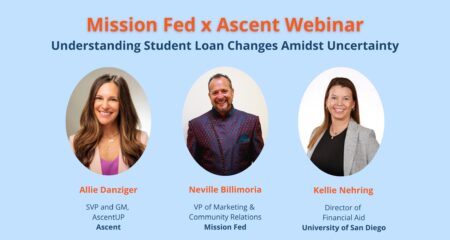 Navigating Change: Key Takeaways from the “Understanding Student Loan Changes Amidst Uncertainty” WebinarWhether you're currently in school, preparing to start, or managing your loan repayment, Ascent provides practical tools and insights to help you make informed financial decisions with confidence. Paying for college can be confusing, especially with all the recent changes to financial aid and student loans. To help make things a little clearer, we partnered with Mission Federal and the University of San Diego to host “Understanding Student Loan Changes Amidst Uncertainty,” a webinar designed for students and families. Ascent’s SVP and GM of AscentUP, Allie Danziger, Mission Fed's VP of Marketing and Community Relations, Neville Billimoria, and University of San Diego’s Director of Financial Aid, Kellie Nehring, shared helpful advice on FAFSA updates, scholarships, student loans, and how to plan for different college paths, whether that’s a four-year university, a community college, or something in between. If you missed the webinar, no worries! You can watch it here but we’ve also summarized the learnings below. Changes to Federal Loan Policy Big shifts are on the horizon—new federal policy changes are set to reshape repayment, forgiveness, and loan eligibility in ways that every student and family should know about. Starting July 1, 2026, federal loan regulations will undergo major updates that will directly impact how students and parents pay for college, beginning with the 2026–2027 academic year. Graduate students will no longer be able to borrow Grad PLUS Loans, a change that could make financing advanced degrees more challenging. For undergraduates, Parent PLUS Loans will still be available, but borrowing will be capped at $20,000 per year—posing funding gaps for families at higher-cost schools while having less effect at more affordable institutions. The good news? If you’re starting school this Fall and plan to use Grad PLUS or Parent PLUS Loans, your borrowing won’t be affected for the upcoming academic year. Still, these upcoming changes are prompting schools to explore creative solutions, from expanding institutional loan options to connecting families with private lenders. For students and parents alike, understanding these shifts early is key to preparing for the future of college financing. Parent PLUS Loans have unique repayment rules that families should understand before borrowing. Eligibility requires a credit check, and repayment begins just 60 days after the second disbursement, often during the spring semester of a student’s first year. These payments cannot be deferred until six months after graduation, meaning parents may need to start making payments while their student is still in school. International students aren’t eligible for federal aid, but they may still qualify for other financial aid programs and resources. Guidance for Navigating Student Loans As you plan for the road ahead, it’s important to understand the key details of student loans to stay informed and make confident financial decisions. Completing the Free Application for Federal Student Aid (FAFSA) each year is the first and most important step in determining your eligibility for federal financial aid. Depending on your situation, you may also need to fill out an institutional or state application to maximize your options. For many students, federal loans will play a key role: subsidized loans are need-based and don’t accrue interest while you’re in school, as long as your Student Aid Index is lower than your school’s cost of attendance. On the other hand, unsubsidized loans begin accruing interest right away, though repayment is deferred until six months after graduation or withdrawal. Once repayment starts, it’s critical to stay on track—missing payments, even during forbearance, can create lasting challenges. Remember, you’ll be repaying the loan servicer that manages your account, so building good habits now will set you up for success after graduation. The good news is that repayment plans can be tailored to your income, giving you some flexibility as you begin your career. Federal student loan interest rates typically shift by about 5–10% each year and reset every July 1st for the upcoming academic year. In contrast, private lenders adjust rates which can make them more competitive depending on the market. Ascent offers low rates and multiple benefits that help students plan, pay, and succeed in college. Our borrowers also receive access to our AscentUP program which provides tools, resources, and coaching, as well as access to paid internship opportunities, to support students on professional development, building confidence, developing new skills, and jumpstart dream careers. More Ways to Pay Beyond student loans, there are several ways to help make college more affordable. Campus jobs offer flexible hours and valuable experience, often available through the financial aid office, athletics department, or housing office. If you qualify, federal work-study can provide an added chance to earn money while gaining valuable experience. The key is to explore these options early at the schools you’re considering, so you can combine resources and create a strategy that makes paying for college feel more manageable. When it comes to paying for college, scholarships are the ultimate win— it’s free money you never have to pay back. There are scholarships out there for nearly everything—academics, athletics, leadership, volunteering, unique hobbies, and even your favorite ice cream flavor. The more you apply for, the more chances you have to stack up real savings. For students 14+, Ascent offers no-essay scholarships! Check out the latest opportunities and enter to win here! As you navigate paying for college, remember that you don’t have to do it alone—your school’s financial aid team is there to support you. Whether it’s asking about scholarships, staying on top of deadlines, appealing for additional aid, or finding out who to contact about repayment options, reaching out early can make a huge difference. Building a relationship with the financial aid office not only helps you avoid frustration and discouragement but also ensures you have a trusted resource to turn to whenever questions come up. Don’t hesitate to ask plenty of questions, seek advice, and lean on the broader network of support around you. By gathering input from multiple sources and staying connected, you’ll be better equipped to make confident, informed decisions about your financial journey!
 -
 Ascent Lowers Annual Percentage Rates (APRs) to Support Students and FamiliesWhy now, what it means, and how it aligns with our mission. At a time when education costs are rising and student debt continues to dominate national conversations, Ascent has lowered interest rates for undergraduate student loans for a limited time. Fixed rates now start as low as 2.89% Annual Percentage Rate (APR)*, down from 3.09% APR, for eligible borrowers. This isn’t just a pricing update. It’s a strategic move rooted in our mission: to reduce financial barriers to education, support stronger borrower outcomes, and deliver long-term value to students and their families. Inside Ascent’s Latest Rate Drop As of August 5, 2025, Ascent offers low fixed rates available for private undergraduate student loans, starting at just 2.89% APR*. This limited-time offer is designed to help ease the financial burden on students and families amid rising education costs. To put this rate reduction into perspective, a $10,000 loan at 2.89% APR on a 5-year repayment plan—meaning fixed monthly payments of $179.20 over 60 months—would cost roughly $10,752.23 in total*. Compared to loans with higher interest rates, that could mean hundreds or even thousands of dollars saved over the life of the loan. Even beyond the numbers, it’s the experience of our borrowers that truly illustrates the difference. Norelle, who recently chose Ascent, shared how our competitive rates and straightforward process made a difference for her: “Loan options and interest rates are competitive, and the process was transparent and easy.” For another borrower, Samantha, the value went deeper than just rates: “It feels like you actually care about me and my goals beyond just a number on a page.” These voices remind us that lowering rates isn’t just a financial decision — it’s about removing barriers and empowering real students to move confidently toward their futures. Why is Ascent Dropping Rates Now? Today’s students are navigating rising tuition, shifts in federal aid, and increasing financial stress. We lowered our rates now to reduce the cost of borrowing at a time when it matters most. Here’s what drove the decision: We Listen to Students: Recent surveys found that over 70% of college students feel stressed about their personal finances, and nearly 60% worry they may not have enough money to pay for school. We want to be part of the solution, not the stress. We Took a Different Path: While many lenders are raising or holding interest rates due to economic uncertainty, we are determined to take a different approach take a different approach—one grounded in accessibility and long-term impact. We Stay Grounded in Our Mission: Our role goes beyond traditional lending. We’re focused on helping students plan, pay, and succeed academically, financially, and professionally. That means building tools, rates, and resources that work in the real world and reflect what students actually need. “By lowering our rates, we’re helping reduce the financial barriers that stand between students and the opportunities they deserve—not just access to education, but a real chance at durable economic mobility,” said Ken Ruggiero, CEO of Ascent. Mission Meets Market Lowering rates isn’t just a pricing decision, it’s a mission decision. At Ascent, we’re building a different kind of student lending model—one focused on outcomes, not just loan origination volume. That means helping students graduate with less debt, build credit, and boost their long-term earning potential. We’re not just funding tuition. Through student-friendly features such as an autopay discount, as well as financial education, and tools like AscentUP**, we’re investing in futures. “We built Ascent to make a real difference in students’ lives,” added Ruggiero. “Helping learners become earners is our commitment. And for many, that starts with an affordable rate.” Does Ascent Anticipate Another Rate Drop? Why or Why Not? While we can’t predict exact changes in the market, Ascent commits to remaining agile and student-focused in our approach. Future changes will be guided by the same principles that drove this one: respond to what students need, stay disciplined in our pricing, and continue evolving our products to meet the moment. Looking Ahead Lowering our rates is one way Ascent is expanding access to education and helping students succeed in school and beyond. Backed by best-in-class teams and technology, we’re constantly improving our financial products and support services to empower students to plan, pay, and thrive. This update to rates, along with flexible repayment options, financial wellness tools, and career resources through AscentUP, reflects our commitment to delivering more than just funding. We’re focused on outcomes—academic, personal, and economic—that last well beyond graduation. About Ascent Ascent is a mission-driven fintech company committed to redefining student lending through a focus on access, affordability, and lasting economic impact. Backed by institutional capital, we offer innovative loan options for college and career training programs—helping more students qualify, with or without a cosigner. But funding is just the start. From career readiness tools to financial wellness resources to over $330,000 in no-essay scholarships, everything we build is designed to turn education into real opportunity. Learn more about how we’re working to increase student income by $10 billion by 2028 in our Impact Report. * =Annual Percentage Rates (APRs) displayed above are effective as of 08/06/2025 and reflect an Automatic Payment Discount of 0.25% on credit-based college student loans submitted prior to 06/01/2025, a 0.5% discount on credit-based college student loans submitted on or after 06/01/2025, and a 1.00% discount on outcomes-based college student loans when you enroll in automatic payments. Loans subject to individual approval, restrictions and conditions apply. Loan features and information advertised are intended for college student loans and are subject to change at any time. For more information, see repayment examples or review the Ascent Student Loans Terms and Conditions. The final amount approved depends on the borrower’s credit history, verifiable cost of attendance as certified by an eligible school and is subject to credit approval and verification of application information. Lowest interest rates require full principal and interest (Immediate) payments, the shortest loan term, a cosigner, and are only available for our most creditworthy applicants and cosigners with the highest average credit scores. Actual APR offered may be higher or lower than the examples above, based on the amount of time you spend in school and any grace period you have before repayment begins. Variable rates may increase after consummation. ** Ascent applicants and borrowers that agree to the AscentUP Terms of Service and Privacy Policy, as well as students associated with an Ascent parent loan application, have access to the AscentUP platform.
 -
 The Forward Fund, NCAHEC and Ascent Funding Partner to Tackle North Carolina’s RN ShortageNorth Carolina’s nursing shortage is projected to reach nearly 12,500 by 2033. To address this shortage, The Forward Fund (TFF) and the North Carolina Area Health Education Centers (NC AHEC) have joined forces to provide zero-interest loans to individuals enrolling in the NC AHEC RN Refresher program offered in collaboration with the University of North Carolina at Chapel Hill School of Nursing. “This partnership is an excellent opportunity to provide RN Refresher students with funding support to eliminate cost as a barrier -to enrollment in the program and subsequently return to nursing workforce. It is a win-win for the RN Refresher and the nursing workforce in North Carolina,” said Dr. Felicia Mosley-Williams, Statewide AHEC Nursing Liaison and Director of the NC AHEC RN Refresher Program. The RN Refresher program provides accelerated, asynchronous education and training for registered nurses with a lapsed license or an active RN looking to update their knowledge. “The RN Refresher program is committed to helping more nurses return to the field, opening a variety of career pathways, and investing in nursing’s commitment to improve the state of healthcare in North Carolina,” said Dr. Jill Forcina, Director of Education and Nursing at NC AHEC. The program consists of 24 self-paced, online modules taught by faculty at the University of North Carolina at Chapel Hill School of Nursing, and a 140-hour clinical practicum managed by local AHECs. Costs for the program are relatively low, however, financial barriers exist preventing RNs from taking advantage of the program. That’s where The Forward Fund’s partnership fills the gap. The Forward Fund will offer zero-interest cost of living loans to individuals enrolling in the RN Refresher program. Loans will vary from $2,000 to $5,000 to cover the cost of living like housing, childcare, and transportation, so RNs can focus on their training and upskilling. “We are proud to partner with NCAHEC and regional area education centers to provide zero-interest financing to support RNs to reenter the workforce,” said Meaghan Dennison, CEO and founder of TFF. “We are thrilled to expand our loan offering to the healthcare space with this partnership.” Loan terms include no minimum credit score, a 3-month grace period upon program completion and a minimum income threshold of $30,000, which accounts for part-time employment. Nurses that do not meet the minimum salary threshold may request income-based deferment, during which period they would have no payments due and remain in good standing with their loan. TFF loans are powered by Ascent Funding as the loan origination and master servicing partner. Once approved, loans are disbursed directly to the student. “We’re thrilled to partner with The Forward Fund and NCAHEC to address the coming nursing shortage by lowering the financial barriers for students,” said Michele Shank, VP, Impact & Senior Counsel from Ascent Funding. “Programs like ours help North Carolina nurses return to work, which only means improved healthcare for all." Interested students learn more about the RN Refresher program here and identify the local contact to be introduced to this financing opportunity. About the Forward Fund The Forward Fund, headquartered in Wilmington, North Carolina, is the state’s only pay-it-forward fund. Dedicated to empowering students, The Forward Fund provides tailored financial support to help students enroll in educational programs, graduate, and secure high-wage employment. This innovative model invests in individual success and ensures local employers gain access to a skilled workforce essential to North Carolina's growth. Website: https://theforward.fund/ LinkedIn: https://www.linkedin.com/company/theforwardfund Contact TFF: https://theforward.fund/contact/ About Ascent Ascent is a leading provider of innovative financial products and wrap-around student support services that enable more students to access education and achieve academic and economic success. Everything Ascent offers is designed by leading industry professionals and with advanced technology and innovation to increase every student’s ability to plan, pay, and succeed. Ascent’s rare Outcomes-Based Loan provides funding to credit-invisible borrowers who generally do not benefit from traditional credit. Ascent products also include: Cosigned Loans, Solo Loans, Career Loans, Parent Loans, Graduate Loans, Access Loans, Enterprise Loans and Impact Loans. For more information, visit www.ascentfunding.com.
 -
 Navigating Education Evolution: An Ask Me Anything session with Ascent’s CEO Ken RuggieroEducation is always evolving, and keeping track of the changes can be overwhelming. From critical FAFSA updates to new Department of Education regulations, staying informed has become increasingly complex. Recognizing these challenges, we're taking a proactive approach to support you. On April 10th, we hosted an exclusive Ask Me Anything (AMA) session with our CEO, Ken Ruggiero, creating a direct line of communication between you and our leadership. The session revealed widespread uncertainty about the impact of recent changes on financial aid processes and next steps. Your concerns are our priority, which is why this AMA was designed to provide clear, authoritative answers to your most pressing questions. Couldn't make it to the live session? We've got you covered. We've carefully compiled the most significant questions and comprehensive answers in this detailed recap. Our goal is to transform uncertainty into understanding, empowering you to navigate these changes with confidence. When you say, "dismantle the U.S. Department of Education," what do you mean? There's been growing discussion about potential changes to the U.S. Department of Education, including the possible transfer of federal student loans to the Small Business Administration (SBA). While nothing has officially changed yet, President Trump issued an executive order on March 20, 2025, to begin dismantling the Department of Education. Following this, he announced that the SBA will take over the administration of the student loan portfolio. That said, there may be some challenges to making these changes a reality. Since much of the federal student loan system is governed by law, it’s not clear how these would be implemented without approval from Congress. We know this news can be confusing and stressful, especially if you’re relying on federal aid right now. But rest assured, your current loans and aid are unaffected for the time being. While these changes may impact future borrowers, we’ll be here to keep you updated and support you through any changes that come your way. Will my payments still be deferred until I finish school? If you chose in-school deferment when you took out your loan from Ascent, your payments will remain deferred as long as you’re enrolled at least half-time. This means you won’t need to make monthly payments until after you graduate or drop below half-time status, depending on your loan terms. It's also important to note that a change in the administrator of the federal student loan program should not affect your eligibility to defer payments while you're in school. However, making early payments during deferment can still reduce your total loan cost and help you get ahead with repayment. I want to know if there will still be funding for students that are going to school outside of private lenders? I thought FAFSA helps us avoid interest on loans. Great question! You’re not alone in wondering this. Yes, federal student aid through FAFSA is still currently available. Nothing has changed how students apply for, or receive, federal grants, work-study, or subsidized loans. While there have been recent discussions about potential shifts in how federal education is managed, no changes to FAFSA or federal aid have been approved at this time. If you’re planning for school, it’s still a good idea to complete your FAFSA application as soon as possible and explore all options- federal and private loans- as well as scholarships to make the best financial decision for your situation. Will FAFSA payments be altered or canceled altogether because of the DOE getting cut? As of today, we haven’t heard anything about FAFSA payments being altered or canceled due to changes with the Department of Education. While there have been some changes within the DOE, they’ve assured that essential programs like FAFSA are still up and running. You can continue applying for financial aid as usual, and we’ll keep you updated if anything changes. Why is FAFSA taking so long this year? FAFSA is taking longer this year due to a major redesign for the 2024–2025 academic year, aimed at simplifying the process. However, technical issues and reduced staffing at the Department of Education have caused delays in processing and sending information to colleges. We know it’s a stressful time, especially when you're waiting on financial details to make decisions, but these delays are part of the transition to the new system. Can I still submit my FAFSA if I haven’t yet? Yes, you can still submit your FAFSA! The federal deadline to submit the FAFSA for the 2024-2025 academic year is June 30, 2025. However, some states and schools have earlier deadlines for their own aid programs. Just keep in mind that some funding might be limited the longer you wait, so try to submit it as soon as you can to maximize your chances of getting the most aid available. How is FASFA and other forms of aid like TAP, going to be affected? And how can people go about paying for their education? We know how important financial aid is, and we want to reassure you that FAFSA and programs like TAP are still available to help you pay for school. There’s been a lot of talk about changes, but for now, nothing has affected these programs, so you can still count on them to support you. With the income-based repayment plan no longer available, how much will students expect to pay monthly in repayments and what advice can you share about how to do this with a small income? Good news – the application process for income-driven repayment (IDR) plans, including SAVE, PAYE, ICR, and IBR, is now open again after a brief pause. This means borrowers can apply for these plans and potentially reduce their monthly payments based on income, providing valuable relief if finances are tight. However, while the application process is back up and running, several provisions of these plans remain on pause. For more details, visit: https://studentaid.gov/announcements-events/idr-court-actions. If you’re working on a smaller income, we recommend looking into one of these plans. Along with that, taking a look at budgeting strategies can help you make the most out of your funds. Don’t forget to check out any forgiveness programs that might be available to you, as well. They could really make a difference in the long run. For further assistance, student borrowers should reach out to their loan servicers or visit the Federal Student Aid website for the most up-to-date guidance and resources. Can you provide general info on a Parent Plus Loan? A Parent Plus Loan is a federal loan that lets parents help cover the cost of their child’s college education. It can cover up to the full cost of attendance, minus any other aid, and has a fixed interest rate of 9.08% for the 2024-2025 school year. This process includes a simple credit check, and while payments usually start after the loan is disbursed, parents can request to defer payments while their student is in school. Thank you for this opportunity. As a prospective international student, what are my chances of getting funding, considering these new changes? Thank you. Ascent offers loans to international students with creditworthy U.S. cosigner. While recent changes to the Department of Education may impact federal loan processes, Ascent’s eligibility for international students remain simple: you’ll need a U.S. cosigner and be enrolled at least half-time. To stay informed about loan options and eligibility criteria, we welcome international students to visit our International Student Loans page. How can I reduce my payments to something actually manageable? Making your loan more manageable is all about staying proactive! You can set up automatic payments to keep things simple and avoid any late fees. If you’re able, try to pay a little extra each month – even small payments can help reduce your balance faster. And remember, the Ascent team is always here to help! To explore more options for making your loan payments more manageable, you can contact Ascent’s customer service team. How can I push for the Department of Education to stop changes?!! It’s understandable to want your voice heard, especially when it comes to something as important as education and student loans. There are lots of ways to get involved – reaching out to your reps, joining advocacy groups, or signing petitions can all help. Here are a few petitions you can sign: Link & Link Find the best way that works for you to get involved. Your voice counts! Why does Ascent care? At Ascent, we’re committed to helping students achieve their goals, and we know education is an important investment in your future. Our goal isn’t just about providing loans – it’s to empower you with clear, accessible options so you can make the best financial choices for your future. Your success means a lot to us, both while you’re in school and beyond.
 -
 Do You Need a Cosigner for Student Loans?Not sure if you need a cosigner for your student loans? Learn more about the different factors you should consider to help you decide.
 -
 What is a Cosigner for a Student Loan?A cosigner is someone who takes legal responsibility for a loan in addition to the primary borrower. Learn more about student loan cosigners.
 -
 Does Cosigning a Student Loan Affect My Credit?The Credit Impact To Cosigning a Student Loan If you’re wondering how cosigning a student loan affects credit, the answer is—it depends. Cosigning a student loan could have positive impacts on your credit, negative impacts on your credit, or no impact on your credit. It depends on how the student borrower, in this case the student whose loan you are cosigning, makes payments. However, many factors can influence the impact of cosigning a student loan on your credit. Is a Cosigner Necessary for All Student Loans? Let’s start with the basics of what is a cosigner. A cosigner is someone who agrees to accept responsibility for the repayment of a loan if the student borrower fails to fulfill their financial obligation. Ultimately, the cosigner assumes the financial risk if the student borrower defaults on their loan or fails to make timely payments. Whether a cosigner is required will depend on the student borrower’s specific financial circumstances and requirements their lender may have. These qualifications generally include financial factors such as the student borrower's age, income, credit score, and other criteria. Even if a student qualifies for a loan without a cosigner, opting to apply with a cosigner can have additional benefits. Depending on the lender, adding a cosigner may help the student qualify for a larger loan and more favorable rates and terms. When is a Cosigner Necessary for Student Loans? Several factors determine whether a cosigner is necessary for college loans or graduate student loans. Some of the student’s criteria that might determine whether a cosigner is required include: Age – Some lenders may require cosigners for student loans if the student borrower is below a certain age, usually between 18 and 22 years old (depending on the state). Credit Score – Most lenders will require a cosigner if the student borrower has no credit history or a low credit score. Employment History – Many lenders will require a cosigner if the student borrower lacks sufficient employment history (this is a common scenario for aspiring college students just finishing high school). Income – Most lenders will require a cosigner if the applicant’s income does not meet the minimum requirement, which is very likely to be the case for many prospective students. Debt-to-Income Ratio – Most lenders will require a cosigner if the applicant’s debt-to-income ratio is above a certain threshold. Even though most private student loan lenders will require a cosigner, not all will, or at least, not in all circumstances. Ascent offers both loans with a cosigner and no-cosigner student loans, depending on your needs and eligibility. How Your Credit Score is Impacted When Cosigning a Student Loan The impact of cosigning a student loan on your credit score is determined by the financial circumstances and planning of the student borrower when paying back the loan. First, any potential cosigner should understand that the student loan application process often involves a hard credit check, also known as a hard inquiry. A hard inquiry is triggered when a lender reviews your credit score to help assess your creditworthiness. This activity will have little to no short-term impact on your credit score. However, too many hard inquiries over a short period can raise a flag to lenders that you are seeking to borrow beyond what you can pay back. In the long-term, determining whether cosigning a student loan will impact your credit score depends on whether the student loan payments are made. If the loan payments are made on time, and the loan is paid back by the required date, the cosigners’ credit score may even improve. Cosigning can help the student borrower and cosigner build credit if they have little or no credit history. On the other hand, if payments are late or the loan defaults, the student borrower and the cosigner will see this reflected on their credit report. In addition to negatively impacting your credit score, as a cosigner, you may be exposed to long-term financial and potential legal consequences should the lender or debt collectors attempt to collect the unpaid debt. Other than the potential impact on your credit score, there are other financial implications of cosigning a student loan. It is important to note that there is no special classification for cosigned student loan debt on your credit score—the borrowed amount will show up as debt just as if you took out the loan yourself. This means that the loan amount will be factored into your debt-to-income ratio, which can affect your creditworthiness until the loan is paid down or off completely. If you are considering cosigning, consider how this debt could impact your future financial opportunities, such as your ability to take out other loan types, like an auto or home loan. Requirements for Cosigning a Student Loan Each student loan provider may have unique requirements regarding who is eligible to cosign a student loan, which may vary by loan type. For example, a lender may have stricter requirements for cosigners of loans above a certain amount. However, there are some common requirements that a student loan cosigner usually needs to meet. U.S. Citizenship – Many U.S.-based lenders require cosigners to be U.S. citizens or permanent residents. Age Requirements – Most lenders have age requirements for cosigners; usually, you must be at least 18. Good Credit History – All lenders require that cosigners meet or exceed a minimum credit score; larger loans may require a higher credit score. Stable Income/Employment History – Lenders often require cosigners to have a verified stable income and employment history. Low Debt-to-Income Ratio – Most lenders will require student loan cosigners to have a debt-to-income ratio that does not exceed a maximum amount. Responsible Financial Management – Lenders often look at the cosigner’s overall financial responsibility, such as their history of making a timely loan or credit card payment. Meeting Requirements Over Time – Many lenders will require that the cosigner not only meet other requirements but have met them for a sustained period, for example, two years. Relationship to Student Borrower – Although this is not a common requirement, most cosigners are family, including parents and close friends. Benefits of Being a Student Loan Cosigner While inherent risks are associated with being a student loan cosigner, there are also potential benefits that may make this decision worthwhile. Some notable benefits of becoming a cosigner include: Facilitating Access to Education - By cosigning a student loan, you play a crucial role in helping someone pursue their education. Access to higher education can open doors to better career opportunities and personal growth for the student borrower. Building or Enhancing Credit History - As a cosigner, you contribute to establishing or improving the student borrower's credit history. Timely repayments can positively impact both the student borrower's and your credit scores, potentially leading to better financial opportunities in the future. Fostering Financial Responsibility - Acting as a cosigner provides an opportunity to mentor and guide the primary borrower through financial planning. By sharing the responsibility, you can impart valuable lessons about budgeting, responsible spending, and meeting financial obligations. Potential for Favorable Loan Terms - Your involvement as a cosigner may help secure more favorable loan terms, such as lower interest rates or more flexible repayment options. This can ease the financial burden on the student borrower and create a more manageable repayment plan. Risks of Being a Student Loan Cosigner There are several risks involved in being a student loan cosigner. Some of the most important things you need to be aware of and look out for include: Full Obligation to Cover the Debt – As a cosigner, you are equally responsible for repaying the full amount of the loan. If the student borrower fails to make payments or defaults, you are legally obligated to cover the debt, which can have long-term financial implications. Negative Impact on Your Credit Score – Being a student loan cosigner can negatively impact your credit. The impact can be especially massive if the student borrower misses payments or defaults. Difficulty in Removing Yourself from the Loan – Depending on the lender, it can be a difficult process to remove a cosigner from a student loan, even if the student borrower has established good credit. Potential Legal Challenges – If the student borrower defaults on the loan, the lender can take legal action against the cosigner. In some cases, this could even result in wage garnishment or legal judgments. What Is a Cosigner Release? A cosigner release is a provision included in some student loan agreements in which the cosigner may be removed from the loan responsibility after meeting specific qualifications. These terms will vary by lender but generally include an analysis of the student borrower’s payment history and qualifications as a solo borrower. The cosigner may be released from the loan once the student borrower meets these conditions and other required terms. If the lender approves the cosigner release, the cosigner is no longer obligated to repay the debt. Having the option of being released from the cosigner obligation reduces the long-term financial risk for the cosigner, as they will no longer be responsible for the financial consequences should the student borrower default on the loan. For example, Ascent borrowers can apply for cosigner release after making the first twelve consecutive, regularly scheduled payments and meeting other eligibility criteria. Learn More with Ascent From applying to college and beyond, Ascent supports students and their families with financial wellness resources and college loan options to help you achieve your financial goals. Learn more about our cosigned student loan options or contact us today for more questions about cosigning a loan from Ascent Funding. FAQ Whose credit is affected on a cosigned loan? The student borrower's and the cosigner’s credit are impacted when applying for a cosigned student loan, but they do so differently. The student borrower is primarily responsible for making timely payments and managing the loan. If the student borrower does so, their credit score will improve, as will the cosigner's. If the student borrower misses payments or defaults on the loan, their credit score will be negatively impacted, as will the cosigner's. However, the cosigner can make loan payments anytime to prevent a missed payment. Can you remove yourself as a cosigner? Whether or not you can remove yourself as a cosigner from a student loan depends largely on the terms of the specific loan and the lender. Removing yourself as a cosigner from a student loan may be difficult unless the lender offers a cosigner release option. How do I protect myself as a cosigner? You can protect yourself as a student loan cosigner in many ways. Some of the most effective and important include: Understand all terms of the loan Communicate openly and regularly with the student borrower about the loan and their financial situation. Review any cosigner release provision in the terms of the loan. Regularly monitor credit reports. Set up payment alerts. Maintain an emergency fund to cover payments. Know your rights and responsibilities as a cosigner. Encourage responsible borrowing.
 -
 The Pros and Cons of Cosigning a Student LoanWeighing the pros and cons of becoming a student loan cosigner? Learn about the benefits and potential risks of being a cosigner on a student loan from Ascent Funding.
 -
 How to Remove a Cosigner from a Student LoanAlthough cosigners can be beneficial, you should know how to remove them from a student loan. Learn how to remove a cosigner with Ascent.
 -
 EFC Meaning: What Happened to EFC?Learn about Expected Family Contribution (EFC), now called the Student Aid Index (SAI), and its role in determining financial aid eligibility.
Tips to save
Ways to earn
Your Ultimate Guide to College Funding
Discover interactive tools, expert insights, and real-world strategies to help you pay for college with confidence.