-
 Ascent Recognized as One of Southern California's Best Places to WorkWe’re proud to share that Ascent has been recognized as one of Southern California’s Best Places to Work by Best Companies Group, an independent organization that honors companies creating strong workplace experiences for their teams. Best Places to Work SoCal is a research-driven program from Best Companies Group that reviews participating companies’ practices, programs, and benefits, then gathers employee feedback about their workplace experience. Companies that meet the program’s criteria are named among the Best Places to Work SoCal. For Ascent, this recognition reflects more than our benefits or programs. It reflects the people who make our work meaningful every day. At Ascent, we’re focused on building a workplace where people feel supported, trusted, and able to grow. Our mission is to help students access education and move toward academic and economic success, and we know that work starts with our own team. When employees feel valued and connected to the work they do, they’re better equipped to make a meaningful impact. Our team is curious, collaborative, and open to new ideas. Leaders encourage learning, create space for feedback, and support career growth across the company. We believe great ideas can come from anywhere, and we work to make sure employees feel heard, included, and empowered to contribute. Supporting employees means supporting the whole person. Ascent offers flexible and hybrid work options, generous PTO and leave policies, paid parental leave, wellness support, continuing education opportunities, and a 401(k) match. These benefits are designed to help team members care for themselves, grow professionally, and build sustainable careers. Recognition is also part of how we show appreciation. Through programs like Cosmic Kudos, professional development opportunities, and company-wide celebrations, Ascent makes time to acknowledge the work happening across the team. It’s one way we help create a culture where people support each other, celebrate progress, and take pride in the impact they’re making. “We’re proud to have built a workplace where employees feel trusted, supported, and genuinely connected to the work they do,” said Emily Skoubo, Director of Human Resources at Ascent. “This recognition reflects the collaborative culture our team has created together and our continued focus on providing an environment where people can grow, contribute, and feel valued.” At its core, Ascent’s culture is people-first and purpose-driven. Team members support one another, celebrate wins together, and stay connected to a shared goal: helping students and families plan for, pay for, and succeed in school. That mix of mission, collaboration, and opportunity is what makes Ascent a great place to work. We’re grateful to every employee who helps shape that culture every day and proud of what we’ve built together. As Ascent continues to grow, we’ll keep investing in our people, strengthening our culture, and creating opportunities for employees to do meaningful work while building rewarding careers. Because when our people succeed, the students and families we serve benefit too.
 -
 Best Student Loan Tips for High School Seniors Attending College in 2026Heading to college in 2026 is exciting, but paying for it can feel stressful, especially if this is your first time dealing with financial aid or student loans. The good news is you don’t have to figure it all out at once. Starting early gives you a big advantage. You can find scholarships, understand federal aid, and figure out which student loan options make sense for you. In this guide, we will walk you through tips on student loans so you know what to expect and exactly how to prepare. Start With the FAFSA as Soon as It Opens One of the first steps every high school senior should take, even if you plan on taking out student loans, is completing the FAFSA (Free Application for Federal Student Aid). This form determines your eligibility for federal grants, work-study, and federal loans and many colleges and scholarships use it to award aid, too. For the 2026–27 academic year, the FAFSA opened up on October 1, 2025, and the deadline to submit in time for most federal aid is June 30, 2027. Submitting early gives you the best chance at available grants and need-based aid, which don’t have to be repaid. Even if you don’t think you’ll qualify for need-based aid, it’s still worth submitting. You might be surprised by what you’re eligible for, and completing it keeps your options open. Apply for Scholarships Early and Often Scholarships are one of the easiest ways to reduce how much you might need to borrow for college. Start looking early and check opportunities at the local, state, and national level, including awards from colleges, community groups, and employers. Even smaller scholarships can add up fast, so don’t overlook them. And remember, Ascent also offers monthly scholarship giveaways! For more information, check out our webinar on How to Pay for College with Scholarships, here. Do Your Homework on Student Loan Options We know student loans can feel overwhelming, but taking a little time now to understand your options can make a big difference later. The goal is to find a private student loan that works for your budget and your future. Private student loans typically come in two types: fixed-rate and variable-rate: Variable-rate loans can go up or down over time with the market. This can save you money if you plan to pay off your loan quickly, but it also comes with more uncertainty. Fixed-rate loans stay the same for the life of your loan, so your payments won’t change. They can give you peace of mind, but your rate won’t drop if market rates go down. Doing a little research now, comparing options, and asking questions can help you pick the loan that’s right for you. And remember, you don’t have to figure this out alone. Parents, guardians, your school’s financial aid office, and the team at Ascent can help you weigh your choices and feel confident about your decision. Plan How Much You Really Need to Borrow When getting ready to apply for a private student loan, plan how much you really need to borrow and only borrow what is necessary. Private lenders limit loans to the cost of attendance, but this does not equal just tuition – this includes things like housing, textbooks, even a laptop. Your college will certify your cost of attendance when you apply and you can likely even see that when you decide to enroll at that school. Smart budgeting can help you minimize your loan amount and avoid extra interest and repayment stress after graduation. Consider a Cosigner for Student Loans If you’re new to credit or have a limited credit history, applying with a cosigner can strengthen your application. A cosigner is who agrees to share responsibility for the loan, often a parent or trusted family member. Because many cosigners have longer credit histories, their involvement can increase your chances of approval, improve your interest rate options and potentially unlock higher borrowing limits. For many students, this is a practical way to access better student loan terms while building their own credit at the same time. Also, keep in mind that some lenders, like Ascent, offer a cosigner release which helps set students up for financial success and removes cosigner’s responsibility. Keep Your Credit and Financial Habits Strong If you decide to use private student loans, your credit score (or a cosigner’s score) may affect approval and interest rates. Learn how credit works, pay bills on time, and avoid opening too many new accounts too quickly. Good habits now can set you up for better borrowing terms and financial confidence later. You’ve got this, and your financial planning now can set you up for success long after graduation! Looking for more information? Check out our Ultimate Guide to Budgeting for College Students. Learn More with Ascent Navigating the student loan application process can be challenging, and Ascent is committed to providing students and families with the financial resources needed to pursue their dreams. From financial wellness resources to our flexible private student loans and undergraduate student loans, we are here to help students and their families make informed decisions about their future in college, and beyond.
 -
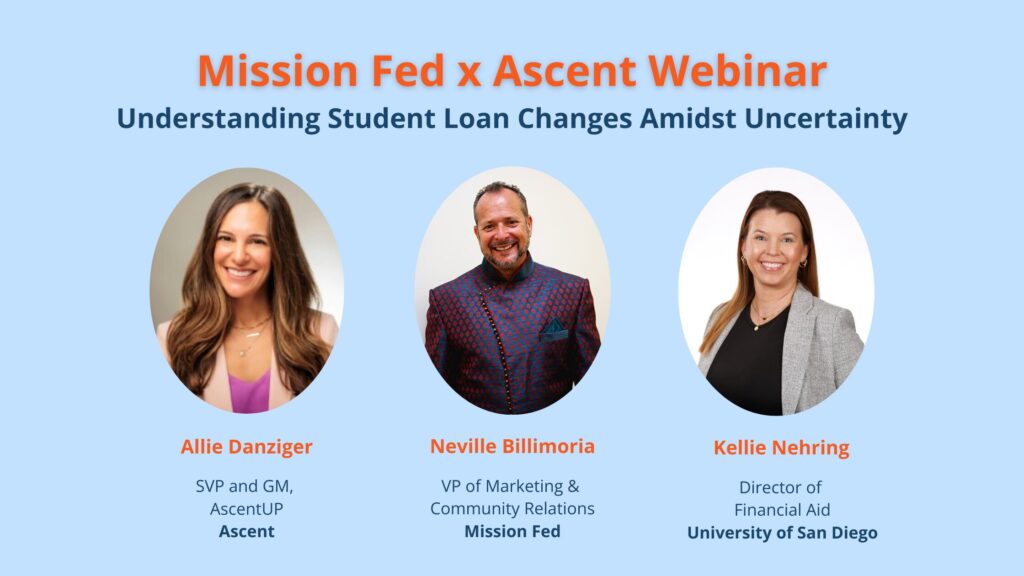 Navigating Change: Key Takeaways from the “Understanding Student Loan Changes Amidst Uncertainty” WebinarWhether you're currently in school, preparing to start, or managing your loan repayment, Ascent provides practical tools and insights to help you make informed financial decisions with confidence. Paying for college can be confusing, especially with all the recent changes to financial aid and student loans. To help make things a little clearer, we partnered with Mission Federal and the University of San Diego to host “Understanding Student Loan Changes Amidst Uncertainty,” a webinar designed for students and families. Ascent’s SVP and GM of AscentUP, Allie Danziger, Mission Fed's VP of Marketing and Community Relations, Neville Billimoria, and University of San Diego’s Director of Financial Aid, Kellie Nehring, shared helpful advice on FAFSA updates, scholarships, student loans, and how to plan for different college paths, whether that’s a four-year university, a community college, or something in between. If you missed the webinar, no worries! You can watch it here but we’ve also summarized the learnings below. Changes to Federal Loan Policy Big shifts are on the horizon—new federal policy changes are set to reshape repayment, forgiveness, and loan eligibility in ways that every student and family should know about. Starting July 1, 2026, federal loan regulations will undergo major updates that will directly impact how students and parents pay for college, beginning with the 2026–2027 academic year. Graduate students will no longer be able to borrow Grad PLUS Loans, a change that could make financing advanced degrees more challenging. For undergraduates, Parent PLUS Loans will still be available, but borrowing will be capped at $20,000 per year—posing funding gaps for families at higher-cost schools while having less effect at more affordable institutions. The good news? If you’re starting school this Fall and plan to use Grad PLUS or Parent PLUS Loans, your borrowing won’t be affected for the upcoming academic year. Still, these upcoming changes are prompting schools to explore creative solutions, from expanding institutional loan options to connecting families with private lenders. For students and parents alike, understanding these shifts early is key to preparing for the future of college financing. Parent PLUS Loans have unique repayment rules that families should understand before borrowing. Eligibility requires a credit check, and repayment begins just 60 days after the second disbursement, often during the spring semester of a student’s first year. These payments cannot be deferred until six months after graduation, meaning parents may need to start making payments while their student is still in school. International students aren’t eligible for federal aid, but they may still qualify for other financial aid programs and resources. Guidance for Navigating Student Loans As you plan for the road ahead, it’s important to understand the key details of student loans to stay informed and make confident financial decisions. Completing the Free Application for Federal Student Aid (FAFSA) each year is the first and most important step in determining your eligibility for federal financial aid. Depending on your situation, you may also need to fill out an institutional or state application to maximize your options. For many students, federal loans will play a key role: subsidized loans are need-based and don’t accrue interest while you’re in school, as long as your Student Aid Index is lower than your school’s cost of attendance. On the other hand, unsubsidized loans begin accruing interest right away, though repayment is deferred until six months after graduation or withdrawal. Once repayment starts, it’s critical to stay on track—missing payments, even during forbearance, can create lasting challenges. Remember, you’ll be repaying the loan servicer that manages your account, so building good habits now will set you up for success after graduation. The good news is that repayment plans can be tailored to your income, giving you some flexibility as you begin your career. Federal student loan interest rates typically shift by about 5–10% each year and reset every July 1st for the upcoming academic year. In contrast, private lenders adjust rates which can make them more competitive depending on the market. Ascent offers low rates and multiple benefits that help students plan, pay, and succeed in college. Our borrowers also receive access to our AscentUP program which provides tools, resources, and coaching, as well as access to paid internship opportunities, to support students on professional development, building confidence, developing new skills, and jumpstart dream careers. More Ways to Pay Beyond student loans, there are several ways to help make college more affordable. Campus jobs offer flexible hours and valuable experience, often available through the financial aid office, athletics department, or housing office. If you qualify, federal work-study can provide an added chance to earn money while gaining valuable experience. The key is to explore these options early at the schools you’re considering, so you can combine resources and create a strategy that makes paying for college feel more manageable. When it comes to paying for college, scholarships are the ultimate win— it’s free money you never have to pay back. There are scholarships out there for nearly everything—academics, athletics, leadership, volunteering, unique hobbies, and even your favorite ice cream flavor. The more you apply for, the more chances you have to stack up real savings. For students 14+, Ascent offers no-essay scholarships! Check out the latest opportunities and enter to win here! As you navigate paying for college, remember that you don’t have to do it alone—your school’s financial aid team is there to support you. Whether it’s asking about scholarships, staying on top of deadlines, appealing for additional aid, or finding out who to contact about repayment options, reaching out early can make a huge difference. Building a relationship with the financial aid office not only helps you avoid frustration and discouragement but also ensures you have a trusted resource to turn to whenever questions come up. Don’t hesitate to ask plenty of questions, seek advice, and lean on the broader network of support around you. By gathering input from multiple sources and staying connected, you’ll be better equipped to make confident, informed decisions about your financial journey!
 -
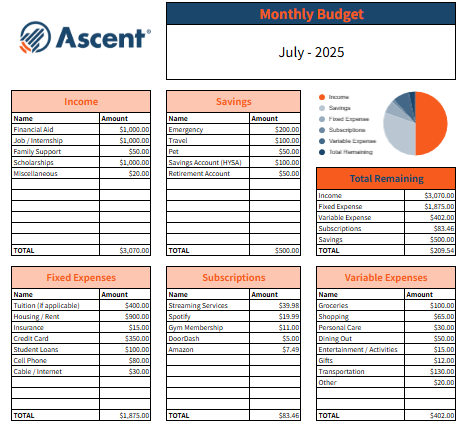 Smart Money Moves: The Ultimate Guide to Budgeting for College StudentsCollege is an exciting time to explore, grow, and gain independence—including getting comfortable with money. Budgeting might sound intimidating, but it’s really just a way to make sure your money supports the life you want to live. With the right strategy and tools, any student can manage money effectively, reduce stress, and set themselves up for future financial success. Why Budgeting is Crucial for College Students Budgeting gives you control over your money, even when it feels like you don’t have much. It helps you cover essentials, avoid debt, and still enjoy life on and off campus. Whether you’re managing a part-time income or student loans, a budget keeps you organized, prepared for surprises, and builds good habits for life after college. Step 1: Understand Your Finances – Creating a Realistic Budget Before you can build a budget that works, you need to understand where your money is coming from and where it’s going. Taking the time to get clear on your income, expenses, and savings goals is the foundation of smart money management. Track Your Income Sources: Before you can plan how to spend or save, it’s important to know how much money you have coming in. Identifying all your income sources will give you a clear starting point for your budget. Financial aid (grants, scholarships, loans) Job income Family support or allowance Know Your Expenses: Prioritize Needs vs. Wants Once you understand your income, the next step is to track your spending. Breaking your expenses into needs and wants can help you make smarter decisions about where your money goes. Fixed Expenses (Needs): Tuition, rent, utilities, insurance, credit cards, bills Variable Expenses (Wants): Food, entertainment, supplies, clothing, personal care Savings: Fund Your Future Saving might not feel urgent right now, but it’s one of the most powerful habits you can start. Even small contributions help you build a financial safety net and encourage long-term habits that will support your goals well beyond college. Savings Accounts: Emergency Fund, travel expenses, pet care High Yield Savings Account: Have higher interest rates and enable faster growth of your savings Retirement Plans (401k, Roth IRA): Tax-advantaged savings plans to help grow savings over time for retirement expenses Use a Budgeting Method Choosing a budgeting method gives structure to your financial plan and helps you stay consistent with your spending, savings, and goals. 50/30/20 Rule: 50% needs, 30% wants, 20% savings/debt repayment This rule helps individuals manage their finances by prioritizing essential expenses, discretionary spending, and long-term financial goals. 50% Needs: Essential expenses you must pay to live and work 30% Wants: Non-essential but enhance quality of life 20% Savings: Strengthening your financial future Envelope Method: Physical or digital envelopes for each category Determine budget categories Set monthly budget for each Withdraw cash and fill envelopes Spend only from those envelopes Step 2: Save Where You Can Once you’ve built a basic budget, the next step is finding ways to stretch your dollars further. The good news? As a college student, there are tons of easy ways to save without sacrificing fun or convenience. From student discounts to smart spending habits, a few small changes can make a big difference. Here’s how to make the most of what you have. Student discounts: Show student ID at restaurants, shopping stores, movie theaters, etc. Apps to get student discounts: UNiDAYS, Student Beans Textbooks: Rent, buy used, library copies Food: Cook at home, use meal plans wisely, avoid daily coffee shop habits, check supermarket ads for deals Transportation: Use public transit, bike, or carpool Most colleges provide free transportation passes Entertainment: Attend free campus events, share streaming accounts Step 3: Prepare for the Unexpected Even the best budgets can be thrown off by surprise expenses. Whether it’s a last-minute trip home, a medical bill, or an extra textbook you didn’t plan for, life happens. That’s why it’s important to build a financial cushion that helps you handle the unexpected without stress—or debt. Here’s how to stay prepared and protect your budget. Build an Emergency Fund: Aim for a $500 goal to start Plan for Irregular Expenses: Books, holidays, trips, birthdays, medical expenses Step 4: Use Tools to Stay on Track Creating a budget is a great start—but staying on track takes a little help. Thankfully, there are plenty of simple tools that can keep you organized and consistent, even on your busiest days. Whether you prefer apps, spreadsheets, or calendar reminders, the right tools can make managing your money quicker, easier, and less stressful. Let’s look at a few that can help you stay in control. Spreadsheets: Custom Google Sheets or Excel Download Ascent’s Student Budgeting Sheet here! Banking Tools: Auto alerts for low balance, spending summaries Calendar Reminders: For bill due dates and budget check-ins Block specific date/time on your calendar to sort your finances Common Budgeting Mistakes to Avoid Even with the best intentions, it’s easy to slip up. Being aware of common budgeting mistakes can help you stay on track and avoid unnecessary stress. Here are a few pitfalls to watch out for: Underestimating daily spending: Every purchase adds up! Not reviewing your budget monthly: Adjust for changes Overlooking one-time costs: Move-in costs, graduation fees, etc. Relying on your credit cards: Make sure you have the funds to pay them back Building Healthy Financial Habits Good budgeting isn’t just about numbers—it’s about building habits that support your goals over time. With a few consistent practices, managing your money can become second nature. Here’s how to turn smart choices into lasting habits: Track every dollar: Even small purchases add up Set time aside time to review your account weekly Set your goals: avoid overdrafts, reduce credit card use Stick to your budget for 3 months? Treat yourself (responsibly)! Final Thoughts Budgeting is an essential skill that can make your college experience less stressful and more empowering. It’s not about getting everything right the first time—it’s about starting small, staying flexible, and learning from your experiences. With a little effort and consistency, you’ll build habits that not only help you thrive in college but also set you up for long-term financial success.
 -
 A Student’s Guide to Smart Summer Spending & SavingIt’s finally summer! Whether you're kicking off your mornings with a run, gaming with friends, or soaking up the sun poolside, this is your time to unwind. While the season is all about fun and freedom, it’s also a great opportunity to be mindful of your money. The choices you make now—both in spending and saving—can set you up for a smoother, more stress-free school year. Save this Summer Open a Savings Account Even small deposits from a paycheck or birthday card can add up fast. Credit unions often offer student-friendly savings accounts that help you set goals, earn interest, and build smart financial habits. You can even automate your deposits—just set it and forget it! SAFE Credit Union has some great savings account options—from traditional savings to high-dividend savings accounts—so you can start your savings journey now. Apply for Scholarships Applying for scholarships is a wonderful way to save money this summer! Ascent Funding offers a $1,000 scholarship giveaway every month; no essay required! Budget Around Plans but Leave Room for Spontaneity Create a simple monthly budget based on your known expenses—like back-to-school shopping, beach days, or a friend’s birthday. Then, add a “spontaneous spending” cap. Whether it’s $30 or $100, this lets you enjoy last-minute BBQs or froyo runs without wondering where your money went. Use SAFE Credit Union’s financial guides or your favorite app to stay on track. Apply the 24-Hour Rule Thinking about that $65 pair of sunglasses or a $90 concert outfit? Wait 24 hours. Still want it tomorrow? Go for it. For bigger purchases, wait 48–72 hours. It gives you time to check your budget and see if it’s really worth it. Use Student Discounts Student status = Savings. Apps like UNiDAYS and Student Beans offer deals on clothes, tech, food, and gym memberships. Always ask: “Do you offer student discounts?” You’d be surprised how often the answer is yes! Try a No-Spend Challenge Pick a weekend—or even just a day— where you only spend on necessities. It’s a fun, low-pressure way to reset your habits, be more intentional, and boost savings. Go on a Staycation You don’t need a passport to have fun. Explore your city like a tourist—check out local concerts, free museum days, night markets, or hiking trails. You’ll save hundreds on travel while still making memories. Smart Summer Splurges Invest in Timeless Summer Staples Choose breathable, durable fabrics like cotton and linen. Stick to neutral colors and classic styles that won’t go out of fashion. Think cost-per-wear for long-term savings. Prioritize Health: Buy the Sunscreen Sunscreen isn’t optional—it’s both self-care and long-term financial protection. A $10 bottle now is less than future medical costs. Pro tip: Buy in bulk or check for student discounts at local stores. Final Thoughts There are infinite ways to spend and save responsibly. It’s an easy way to stay in control of your money this summer, and come fall, you’ll be glad you did! About the Author Kristina Nguyen is a community college student studying Business Administration with an emphasis in Marketing. As President of the Business Club and Transfer Club at her school, she helps students navigate the transfer process, connect with industry professionals, and access scholarship resources. After graduating from high school at 16, Kristina entered community college unsure of what to expect and unaware of the many opportunities available. Now, as she prepares for her own transfer to a four-year university, she’s passionate about helping other students feel confident in their journey and realizes there’s no shame in taking an alternative route to their goals.
 -
 Learn to Save Smart with Student DiscountsBalancing the costs of being a student can get complicated and expensive. Whether you’re worried about textbooks, rent, meals, or any other expenses, student discounts can help lighten the load. In this blog, we’ll shine light on some great discounts that companies offer for students like you. Remember, while saving money is a win, it’s still smart to stick to your budget—don’t overspend just because it’s a good deal! Technology As a college student, having access to technology is essential, but thisit can also get really costly. Let’s explore some discounts tech companies offer to students to help ease the cost. Apple Apple offers exclusive discounts not only for college students but also for parents, faculty, and staff. Enjoy special pricing on Macs, iPads, and select accessories. Microsoft Microsoft offers discounts for students and teachers. They offer discounts on their Surface laptops and access to Microsoft Teams, Word, Excel, PowerPoint, and more for free. With your student email, it is available until you graduate. Dell You can create a free Dell Rewards account with your email and get savings after getting verified as a college student. Their rewards system allows you to get cash back to put towards your future Dell.com purchases. HP HP’s online education store offers up to 40% as part of their membership benefits. This includes discounts on laptops, desktops, accessories and printers. Streaming Spotify It’s always nice to have some music, a podcast, or an audio book to get you through the day as a student. Spotify offers 50% off their premium monthly subscription for students. All you have to do is verify your college student enrollment with the SheerID verification form. You can also bundle this subscription with Hulu for even more savings! HBO Max Looking for a movie or show to watch between your study breaks and free time? Max offers students a 50% off discount for their streaming services. Apple Music Apple Music has got you covered with music, radio stations, and a discount too. Whether you are earning your associate, bachelor’s or postgraduate degree, you can get a special rate made just for students. Going out Piada One reason you should keep your student ID on you: Piada’s student special! You can get any sized entree and a large fountain drink for just $9, every day from 2-5pm, and all day on Wednesdays. Cinemark & AMC Looking to catch the latest blockbuster? Take a break from studying and check out nearby Cinemark theatre to see if they offer student discounts! You can enjoy special pricing with your student ID. Other theaters like AMC also provide student discounts, so don’t forget to ask about those deals too! Museum Discounts Whether you are traveling, or considering being a tourist in your own college town,, always call or check local museum websites for student deals. Some offer free hours or discounted prices with your student ID! Bank of America also offers free admission at participating museums to cardholders during the first weekend of every month . Ascent We offer great benefits to help students earn cash and savings too! Get a discount on your student loan when you enroll in automatic payments. When you sign up, you can save money with the 0.25%-1.00%* autopay discount. Not only are you getting the discount, but you won’t have to worry about missing any payments! Plus, it takes as little as $1 per month to qualify. Ascent student graduates get 1% of their total loan amount back in cash with our graduation reward**. We are proud of your accomplishment and want to celebrate you! Refer a friend and earn big! Recommend your friends to Ascent and you can earn an Amazon.com Gift Card for each friend you refer ***. The more you refer, the more you can earn. The more friends you refer, the more you can earn—everyone wins. Additional Sources There are also other resources like Student Beans and UNiDAYS where they give students access to more exclusive offers. After you've signed up and verified your student status, you unlock access to discounts for travel, food, clothing, and more! Conclusion Don’t miss out on any student discounts and benefits, a little can go a long way. Saving on technology, entertainment, and dining out can help you save extra money to put away for your expenses during your time in school. Take advantage of your student ID, make smart financial decisions, and be on the lookout for ways you can save for the future and set yourself up for success. * The final ACH discount approved depends on the borrower’s credit history, verifiable cost of attendance, and is subject to credit approval and verification of application information. Automatic Payment Discount of 0.25% is for credit-based loans and a 1.00% discount is for outcomes-based loans when you enroll in automatic payments. For more information, see repayment examples or review the Ascent Student Loans Terms and Conditions. ** Ascent’s 1% Cash Back Graduation Reward is for eligible college students only and subject to terms and conditions. Eligible students must request the graduation reward from Ascent. Aggregate cash back limit of $500. Learn more at AscentFunding.com/CashBack. *** Refer a Friend program is subject to terms and conditions, click here for official rules and eligibility. Restrictions apply, see amazon.com/gc-legal Ascent Written, Native Advertising Disclosure Ascent Funding, LLC (“Ascent”) sponsors these blog posts and creates informational content that is of interest to prospective borrowers and our applicants. The information included in this blog post could include technical or other inaccuracies or typographical errors. It is solely your responsibility to evaluate the accuracy, completeness and usefulness of all opinions, advice, services, merchandise and other information provided herein. ASCENT IS NOT RESPONSIBLE FOR, AND EXPRESSLY DISCLAIMS ALL LIABILITY FOR, DAMAGES OF ANY KIND ARISING OUT OF USE, REFERENCE TO, OR RELIANCE ON ANY INFORMATION CONTAINED WITHIN THESE BLOG POSTS (INCLUDING THIRD-PARTY SITES). ASCENT OFFERS LINKS TO THIRD PARTY WEBSITES AND ARTICLES SOLELY FOR INFORMATIONAL PURPOSES. WHEN YOU CLICK ON THESE LINKS YOU WILL LEAVE THE ASCENT WEBSITE AND WILL BE REDIRECTED TO ANOTHER SITE. THESE SITES ARE NOT UNDER THE DIRECTION OR CONTROL OF ASCENT. WE ARE NOT AN AGENT FOR THESE THIRD PARTIES NOR DO WE ENDORSE OR GUARANTEE THEIR PRODUCTS OR THEIR WEBSITE CONTENT. ASCENT MAKES NO REPRESENTATIONS REGARDING THE SUITABILITY OR ACCURACY OF THE CONTENT IN SUCH SITES AND WE ARE NOT RESPONSIBLE FOR ANY OF THE CONTENT OF LINKED THIRD PARTY WEBSITES. As current and former students, we provide free resources to help you throughout your education, which may include links to third-party websites (where security and privacy policies may differ from Ascent’s). For our full disclaimer, please click here.
 -
 Navigating Education Evolution: An Ask Me Anything session with Ascent’s CEO Ken RuggieroEducation is always evolving, and keeping track of the changes can be overwhelming. From critical FAFSA updates to new Department of Education regulations, staying informed has become increasingly complex. Recognizing these challenges, we're taking a proactive approach to support you. On April 10th, we hosted an exclusive Ask Me Anything (AMA) session with our CEO, Ken Ruggiero, creating a direct line of communication between you and our leadership. The session revealed widespread uncertainty about the impact of recent changes on financial aid processes and next steps. Your concerns are our priority, which is why this AMA was designed to provide clear, authoritative answers to your most pressing questions. Couldn't make it to the live session? We've got you covered. We've carefully compiled the most significant questions and comprehensive answers in this detailed recap. Our goal is to transform uncertainty into understanding, empowering you to navigate these changes with confidence. When you say, "dismantle the U.S. Department of Education," what do you mean? There's been growing discussion about potential changes to the U.S. Department of Education, including the possible transfer of federal student loans to the Small Business Administration (SBA). While nothing has officially changed yet, President Trump issued an executive order on March 20, 2025, to begin dismantling the Department of Education. Following this, he announced that the SBA will take over the administration of the student loan portfolio. That said, there may be some challenges to making these changes a reality. Since much of the federal student loan system is governed by law, it’s not clear how these would be implemented without approval from Congress. We know this news can be confusing and stressful, especially if you’re relying on federal aid right now. But rest assured, your current loans and aid are unaffected for the time being. While these changes may impact future borrowers, we’ll be here to keep you updated and support you through any changes that come your way. Will my payments still be deferred until I finish school? If you chose in-school deferment when you took out your loan from Ascent, your payments will remain deferred as long as you’re enrolled at least half-time. This means you won’t need to make monthly payments until after you graduate or drop below half-time status, depending on your loan terms. It's also important to note that a change in the administrator of the federal student loan program should not affect your eligibility to defer payments while you're in school. However, making early payments during deferment can still reduce your total loan cost and help you get ahead with repayment. I want to know if there will still be funding for students that are going to school outside of private lenders? I thought FAFSA helps us avoid interest on loans. Great question! You’re not alone in wondering this. Yes, federal student aid through FAFSA is still currently available. Nothing has changed how students apply for, or receive, federal grants, work-study, or subsidized loans. While there have been recent discussions about potential shifts in how federal education is managed, no changes to FAFSA or federal aid have been approved at this time. If you’re planning for school, it’s still a good idea to complete your FAFSA application as soon as possible and explore all options- federal and private loans- as well as scholarships to make the best financial decision for your situation. Will FAFSA payments be altered or canceled altogether because of the DOE getting cut? As of today, we haven’t heard anything about FAFSA payments being altered or canceled due to changes with the Department of Education. While there have been some changes within the DOE, they’ve assured that essential programs like FAFSA are still up and running. You can continue applying for financial aid as usual, and we’ll keep you updated if anything changes. Why is FAFSA taking so long this year? FAFSA is taking longer this year due to a major redesign for the 2024–2025 academic year, aimed at simplifying the process. However, technical issues and reduced staffing at the Department of Education have caused delays in processing and sending information to colleges. We know it’s a stressful time, especially when you're waiting on financial details to make decisions, but these delays are part of the transition to the new system. Can I still submit my FAFSA if I haven’t yet? Yes, you can still submit your FAFSA! The federal deadline to submit the FAFSA for the 2024-2025 academic year is June 30, 2025. However, some states and schools have earlier deadlines for their own aid programs. Just keep in mind that some funding might be limited the longer you wait, so try to submit it as soon as you can to maximize your chances of getting the most aid available. How is FASFA and other forms of aid like TAP, going to be affected? And how can people go about paying for their education? We know how important financial aid is, and we want to reassure you that FAFSA and programs like TAP are still available to help you pay for school. There’s been a lot of talk about changes, but for now, nothing has affected these programs, so you can still count on them to support you. With the income-based repayment plan no longer available, how much will students expect to pay monthly in repayments and what advice can you share about how to do this with a small income? Good news – the application process for income-driven repayment (IDR) plans, including SAVE, PAYE, ICR, and IBR, is now open again after a brief pause. This means borrowers can apply for these plans and potentially reduce their monthly payments based on income, providing valuable relief if finances are tight. However, while the application process is back up and running, several provisions of these plans remain on pause. For more details, visit: https://studentaid.gov/announcements-events/idr-court-actions. If you’re working on a smaller income, we recommend looking into one of these plans. Along with that, taking a look at budgeting strategies can help you make the most out of your funds. Don’t forget to check out any forgiveness programs that might be available to you, as well. They could really make a difference in the long run. For further assistance, student borrowers should reach out to their loan servicers or visit the Federal Student Aid website for the most up-to-date guidance and resources. Can you provide general info on a Parent Plus Loan? A Parent Plus Loan is a federal loan that lets parents help cover the cost of their child’s college education. It can cover up to the full cost of attendance, minus any other aid, and has a fixed interest rate of 9.08% for the 2024-2025 school year. This process includes a simple credit check, and while payments usually start after the loan is disbursed, parents can request to defer payments while their student is in school. Thank you for this opportunity. As a prospective international student, what are my chances of getting funding, considering these new changes? Thank you. Ascent offers loans to international students with creditworthy U.S. cosigner. While recent changes to the Department of Education may impact federal loan processes, Ascent’s eligibility for international students remain simple: you’ll need a U.S. cosigner and be enrolled at least half-time. To stay informed about loan options and eligibility criteria, we welcome international students to visit our International Student Loans page. How can I reduce my payments to something actually manageable? Making your loan more manageable is all about staying proactive! You can set up automatic payments to keep things simple and avoid any late fees. If you’re able, try to pay a little extra each month – even small payments can help reduce your balance faster. And remember, the Ascent team is always here to help! To explore more options for making your loan payments more manageable, you can contact Ascent’s customer service team. How can I push for the Department of Education to stop changes?!! It’s understandable to want your voice heard, especially when it comes to something as important as education and student loans. There are lots of ways to get involved – reaching out to your reps, joining advocacy groups, or signing petitions can all help. Here are a few petitions you can sign: Link & Link Find the best way that works for you to get involved. Your voice counts! Why does Ascent care? At Ascent, we’re committed to helping students achieve their goals, and we know education is an important investment in your future. Our goal isn’t just about providing loans – it’s to empower you with clear, accessible options so you can make the best financial choices for your future. Your success means a lot to us, both while you’re in school and beyond.
 -
 The Best Tips for Transferring from a Community College to a 4-Year UniversityMany students dream of attending top universities like UCLA, UC Berkeley, USC, or Ivy League schools such as Columbia and Cornell, but face two major obstacles: competitive admissions and high tuition costs. A common misconception is that if you don’t get into your dream school straight out of high school, you’re stuck with your alternative. What many people don’t realize is that transferring is a strategic move—not a backup plan. By completing general education requirements at a community college, students can cut tuition costs in half while keeping their options open for prestigious four-year universities. Why Starting at Community College Can Save You Thousands College tuition has never been higher, making cost a major factor in choosing a school. According to the Education Data Initiative, the average cost of attendance for students living on campus at a four-year university is: In-State Public University: $27,146 per year, which is $108,584 over four years Out-of-State Public University: $45,708 per year, which is $182,832 over four years Private Nonprofit University: $58,628 per year, which is $234,512 over four years These figures don’t include expenses like textbooks, food, and transportation, which add thousands more per year. In comparison, community college tuition is typically under $5,000 per year. Since your first two years are often focused on general education classes—completing them at a community college cuts overall tuition costs in half while still earning the same degree once you transfer. Some states even offer tuition-free community college programs, like the California Promise or Tennessee Promise, which help eligible students attend with little to no cost. Depending on your state and financial situation, enrollment fees may also be waived. Transfer Admission Guarantee (TAG): A Direct Path to a UC For students attending a California Community College (CCC), the UC Transfer Admission Guarantee (TAG) program offers guaranteed admission to one of these six UC campuses: UC Davis UC Irvine UC Merced UC Riverside UC Santa Barbara UC Santa Cruz While TAG does not apply to UCLA, UC Berkeley, or UC San Diego, students can still apply to those schools through the regular UC transfer process. To qualify for TAG, CCC students (including international students) must: Maintain at least a 3.4 GPA in transferable courses (some majors require higher) Complete required coursework, including IGETC (Intersegmental General Education Transfer Curriculum, California’s general ed transfer pathway) and major preparation courses Earn at least 30 transferable semester units before applying and 60 by the time of transfer TAG applications are submitted between September 1–30, a year before transfer. Students must still complete the UC application in November. UCLA Transfer Alliance Program (TAP) If you’re aiming for UCLA, the Transfer Alliance Program (TAP) provides priority admission consideration for students who complete an honors program at a participating California Community College. TAP students who aren’t accepted into their first-choice major may also be considered for an alternate major, giving them a better chance of admission in UCLA’s competitive transfer process. Other State Transfer Guarantees While TAG and TAP are specific to California, many other states offer similar programs: SUNY (New York): Transfer Guarantee to a four-year SUNY school Florida’s 2+2 Transfer Program: Guaranteed university admission after earning an AA degree University of Texas CAP: Transfer agreements with top schools like UT Austin No matter where you live, many universities have formal transfer agreements that allow students to start at a more affordable college before transitioning to a top university. How to Use Student Loans (and Private Loans) Strategically The cost of attendance for college isn’t just about tuition—it includes textbooks, supplies, food, housing, and transportation. These additional expenses can add up quickly, making financial aid and scholarships essential for many students. Filing the FAFSA (Free Application for Federal Student Aid) is the first step to determining eligibility for financial aid such as: Pell Grants (need-based, no repayment required) Federal student loans (low-interest loans with flexible repayment options) Work-study programs (part-time jobs that help students earn money while in school) If grants and federal loans don’t fully cover your expenses, private student loans can help bridge the gap. Private student loans are offered by banks, credit unions, and lenders like Ascent to cover extra costs such as tuition, housing, and other school-related expenses. Unlike some federal loans, private loans may require a credit check or cosigner but often provide competitive rates and flexible repayment options. Ascent stands out by offering both cosigned and non-cosigned student loans, giving students more flexibility when financing their education. You can check your rates in less than 3 minutes without impacting your credit score. Ascent provides free resources, tools, and scholarship opportunities to help students make informed decisions about paying for college. Scholarships for Transfer Students Many universities and private organizations offer scholarships specifically for transfer students, helping reduce tuition costs and reliance on loans. Some notable scholarships include: USC Transfer Merit Scholarship UCLA Transfer Scholarship Texas Christian University Transfer Scholarships Jack Kent Cooke Foundation Undergraduate Transfer Scholarship Phi Theta Kappa (PTK) Scholarships Coca-Cola Academic Team Scholarship In addition to these, Ascent has given away over $330,000 in scholarship giveaways to date and is always adding more scholarship opportunities—open to all students, with no essay or GPA requirement. These Ascent scholarship giveaways are a great opportunity for transfer students to earn extra money toward tuition, books, or other school expenses. Smart Borrowing Tips For students who need to take out loans, borrowing wisely is key to avoiding excessive debt. Here are a few smart borrowing tips: Borrow only what you absolutely need for essential education costs Set up autopay to qualify for interest rate discounts and avoid missed payments Consider making monthly payments while in school—even small amounts like $25/month help you pay off your loan faster If you’re exploring private loans, Ascent offers flexible private student loans designed for transfer students with both cosigned and non-cosigned options, competitive rates, and repayment plans built to fit your needs. By making informed financial decisions, students can maximize the benefits of transferring while keeping costs manageable. Bonus Resource: Ascent also offers AscentUP, which is an online platform with 50+ hours of expert content designed to help students build financial skills, stay on track academically, and prepare for their careers. It’s free for borrowers and a great way to boost your financial confidence while working toward graduation, and gain access to remote, paid internship opportunities. Final Thoughts: Transferring is a Smart Financial Strategy Starting at a community college is a clear and cost-effective path to a top university while keeping your education expenses under control. When used wisely, student loans can be an investment in a better education and future earning potential. Scholarships, transfer programs like TAG and TAP, and smart borrowing strategies can help students graduate from a prestigious university with significantly less debt. Transferring is a strategic way to earn the same degree at a fraction of the cost. With the right planning, you can position yourself for success at your dream school while keeping your financial future secure. Whether you’re just starting out at community college or preparing to transfer to your dream school, Ascent is here to help. From flexible private student loans to monthly scholarships and resources like AscentUP, we’re committed to helping students fund their education and their future responsibly. Explore your options with Ascent today! About the Author Kristina Nguyen is a community college student studying Business Administration with an emphasis in Marketing. As President of the Business Club and Transfer Club at her school, she helps students navigate the transfer process, connect with industry professionals, and access scholarship resources. After graduating from high school at 16, Kristina entered community college unsure of what to expect and unaware of the many opportunities available. Now, as she prepares for her own transfer to a four-year university, she’s passionate about helping other students feel confident in their journey and realizes there’s no shame in taking an alternative route to their goals.
 -
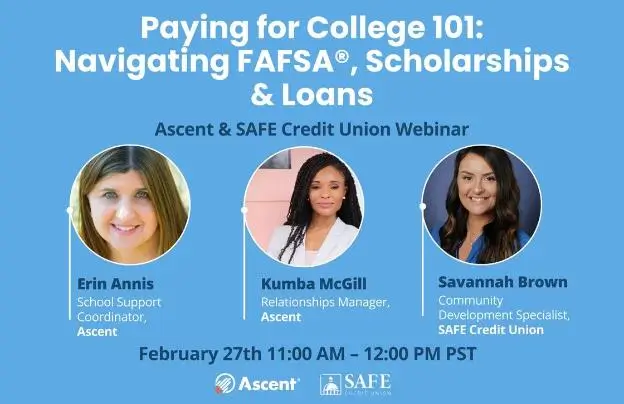 Major Takeaways from Ascent & SAFE Credit Union Webinar: Paying for College 101Major Takeaways from Ascent & SAFE Credit Union Webinar: Paying for College 101: Navigating FAFSA®, Scholarships & Loans With tuition costs on the rise, securing financial aid is key to making higher education more affordable and reducing financial stress. Understanding your options—grants, scholarships, work-study programs, and student loans—can help you navigate the process with confidence. We partnered with SAFE Credit Union to host a webinar, “Paying for College 101: Navigating FAFSA®, Scholarships & Loans.” We gathered expert panelists from Ascent including Erin Annis, School Support Coordinator, and Kumba McGill, Relationships Manager, to speak with the Event Host, Savannah Brown, Community Development Specialist at SAFE Credit Union. The discussion focused on demystifying financial aid, offering practical tips, guiding students through the FAFSA process, and answering valuable questions. If you missed the webinar, no worries! Feel free to watch it here. Understanding your financial aid options is crucial for making informed decisions about financing your education. Our panelists thoroughly reviewed four types of financial aid: federal and state grants, scholarships, work-study programs, and student loans. FAFSA®, also known as the Free Application for Federal Student Aid, is the key to accessing federal financial aid, including grants, scholarships, work-study, and loans, with many states and colleges using it for additional aid. Submitting it early maximizes funding opportunities, making college more affordable through need-based aid and low-interest loans. Our panelists suggest that if you have these qualities, you are eligible to submit an application: Financial Needs You need money to help pay for your education High School Diploma or GED U.S. Citizen and eligible non-Citizens Enrolled or accepted in an eligible degree or certificate program To maintain your eligibility, we advise you to do the following: Maintain a +2.0 GPA Do not default on any student loans Keep your non-citizen status intact Do not get it revoked Enroll in a qualifying degree/certificate program Reach the maximum amount you can borrow from the federal government for a lifetime To get you started, our panelists guided students and parents through the process of how to complete the FAFSA application. Before beginning the process, here are some quick notes: Students should start and complete this application as soon as possible and regardless of if they think they qualify Parents will have to fill out their own sections if students are dependent Under the age of 24, not married, no children, not in the military or homeless Students and parents must use different email addresses when creating their FSA ID Pro Tip: If you're unsure about a question, use the “Hint (?)” icons for guidance on providing exactly what is needed. Next, our panelists recommend you grab a cup of coffee or tea to carry you through this hefty process: To stay prepared, you should have the following documents beside you: 2023 federal tax forms and W-2's Untaxed income Child support Verterans’ non-educated benefits Supplemented Support Income (SSI) Cash and investment balances Your top schools Up to 20 options Financial aid offers Here are the steps to completing the FAFSA application: Log into FAFSA.gov Use your FSA ID Used as your electronic signature Save this along with your password! If you submitted FAFSA last year, use same FSA ID Fill out FAFSA Sections 36 questions Enter basic demographic information Insert your college choices Choose your dependency status Questions to determine your dependency If dependent, answers all questions “No” Parents need to fill out their portion Fill out parents’ information and income IRS DRT: invite, consent, and approval are required Fill out student income IRS DRT Sign, submit, and you are all done! Included are important due dates and deadlines to consider: 2025-2026 FAFSA forms are available now! Submit them by 11:59 CT, June 30, 2025 Schools send financial aid offers estimated by mid-to-late February Look out for the following: School/ state deadlines for institution or state aid/grant School offers Institution aid First come first serve Complete the application as soon as possible! Phew! Now that we have covered the FAFSA application process, you have access to a wide range of financial aid opportunities. In addition to federal and state grants, we’ve outlined three more key sources of financial aid to help support your education: Scholarships & Grants: “Free Money,”, no payment required! Federal & State Grants Free aid based on financial needs (ex. Pell Grants, FSEOG) Scholarships Merit-based, need-based, specialized opportunities Local & national databases provide access to thousands of scholarships Private companies and organizations To date, Ascent has given away over [scholarship_awards_amount] in scholarships to students and families. Enter now for a chance to win one of our easy-to-apply, no-essay scholarships! You do not need to have an Ascent loan to enter. Here are some strategies to secure a scholarship or grant: Tailor your applications to the specific scholarship/grant Write compelling essays that draw in your readers Track deadlines – apply early! Work Study Programs: Earn While You Learn Need-Based Aid Paid towards tuition Determined by FAFSA Part-Time Employment Earn money for expenses through on-campus employment Direct Pay & Earnings Wages paid directly to students, not applied to tuition How to Apply? Job Application is required Apply for and be hired by campus departments Funding for campus jobs Departments receive funding for positions, students actively seek & secure employment to utilize the award Student Loans: Federal vs. Private Federal (FAFSA required!) Lower interest rate, flexible repayment options Subsidized loans: interest is not charged while in school Unsubsidized loans: interest is charged while in school Private Best used after exhausting all federal aid options Compare lenders: interest rates, repayment terms, benefits Paying for college may seem overwhelming, but with the right resources and knowledge, you can navigate the financial aid process with confidence. From FAFSA® and scholarships to work-study programs and student loans, there are many ways to make higher education more affordable. By applying early, exploring all funding options, and staying informed about deadlines, you can maximize your financial aid opportunities and set yourself up for success. Remember, you're not alone on this journey! Ascent and SAFE Credit Union are here to support you with valuable resources, scholarships, and guidance.
 -
 Finding a Cosigner for Your Student LoansFinding a cosigner for your student loan can be a difficult process. Ascent has four tips for finding a cosigner for your student loan.
 -
 Pros and Cons of Community College Compared to UniversityMore high school grads are going straight to community college after graduation. Learn why students are choosing community college after high school.
Tips to save
Ways to earn
Your Ultimate Guide to College Funding
Discover interactive tools, expert insights, and real-world strategies to help you pay for college with confidence.