Ascent’s Grad School Impact Calculator: Estimate Your Program’s Exposure to the Grad PLUS Change

Starting in the 2026–2027 academic year, new graduate and professional students will no longer have access to Grad PLUS loans. For many institutions, this is a real enrollment and access risk.
Grad PLUS has often been the “last-mile” funding that lets students bridge the gap between federal loan limits and the full cost of attendance. When that bridge goes away, schools are left with a practical question: how big is the gap for your incoming cohorts, and what would you need to replace (or rethink) to keep your enrollment plans on track?
Ascent built the Grad School Impact Calculator to help institutions put real numbers around that exposure. In a few minutes, you can plug in program basics (cost of attendance, program length), enrollment assumptions for incoming cohorts, and your historical aid mix to estimate the funding gap tied to the Grad PLUS change.
Below, we’ll quickly cover why the Grad PLUS change matters for institutions, then walk through how to use the calculator: what to enter, how to interpret the funding gap, and how to save/share results with stakeholders.
Background on Grad PLUS Loans: Why Does this Funding Gap Matter for Your Institution?
Grad PLUS loans have historically filled the gap between federal loan limits and the true cost of attendance for graduate students. Federal data shows that while only 16% of graduate students rely on the program, Grad PLUS accounted for 32% of all federal graduate lending, showing just how central it became in helping students pursue advanced degrees.
Even if Grad PLUS borrowers are a minority of students, the exposure can be concentrated in specific programs and cohorts, really impacting students that relied on this funding. In other words, the impact isn’t “16% across the board”; it can be much higher where the gap between loan limits and cost of attendance is largest.
For institutions, Grad PLUS has helped stabilize enrollment by making the full cost of attendance financeable for more students. Federal data shows the scale of the program: about 1.8 million borrowers hold Graduate PLUS loans totaling approximately $119.2 billion in debt, an indicator of how significant this transition could be for future students trying to enhance their futures.
High-cost graduate programs, such as law, medicine, and business, are especially affected. These programs often carry tuition and fees that far exceed federal loan limits, and students frequently rely on layered financing, including Grad PLUS loans, to cover living expenses and program costs.
For schools, this shortfall could translate into fewer enrollments, particularly among underrepresented groups.
Use the Calculator to Quantify Your Grad PLUS Funding Gap
The calculator shows what the Grad PLUS change could mean for your program: how much funding may disappear for new borrowers, when the impact shows up, and how large the resulting gap could be under your assumptions.
Using a few key inputs, the tool helps schools:
- Estimate the size of the Grad PLUS gap for a specific program and cohort plan
- Stress-test scenarios (flat vs. growing enrollment, different COA increases, different aid mixes)
- Translate the gap into “what would we have to replace to hit our enrollment goals?”
- Create a shareable results view to align financial aid, enrollment, and leadership
Instead of leaning on national averages, the calculator reflects your program’s structure, costs, and enrollment assumptions, so the output is something you can actually plan around.
How to Use the Grad School Impact Calculator
Use this quick walkthrough to complete the Grad School Impact Calculator and capture results you can share internally.
First, Enter Your Program Details

Start by entering the basics for the program you’re modeling: select the program type, enter the program length, and add your annual cost of attendance (COA). If your COA typically increases year over year, include an annual increase so the estimate reflects what future cohorts will actually face.
Enter Enrollment Assumptions for New Cohorts
Add the number of students you expect to enroll, starting with 2026–2027 (the first cohort impacted for new borrowers).
- If you have a detailed forecast, enter enrollment year-by-year so the results reflect planned changes (like a cohort expansion or a new concentration).
- If you’re earlier in planning, use a growth assumption (if available) to quickly model flat vs. modest growth scenarios.
Enter Your Historical Aid Mix
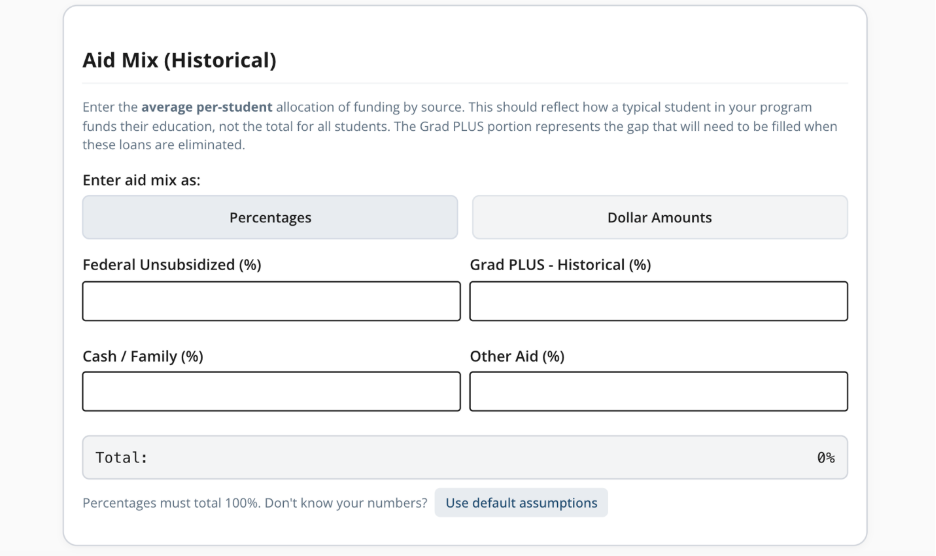
Input your average per-student funding breakdown (including the historical Grad PLUS portion). This is the lever that drives the estimate: the calculator uses it to translate “Grad PLUS goes away for new borrowers” into a dollar gap for your program.
- Use recent averages if you have them (by program, not institution-wide) so the output reflects how your students typically finance the COA.
- If you’re unsure, start with a best estimate, run the calculator, then refine once financial aid/enrollment teams confirm the numbers.
- If your program has distinct populations (e.g., full-time vs. part-time), consider running separate scenarios so you don’t blend very different aid patterns.
Review and Save Your Results
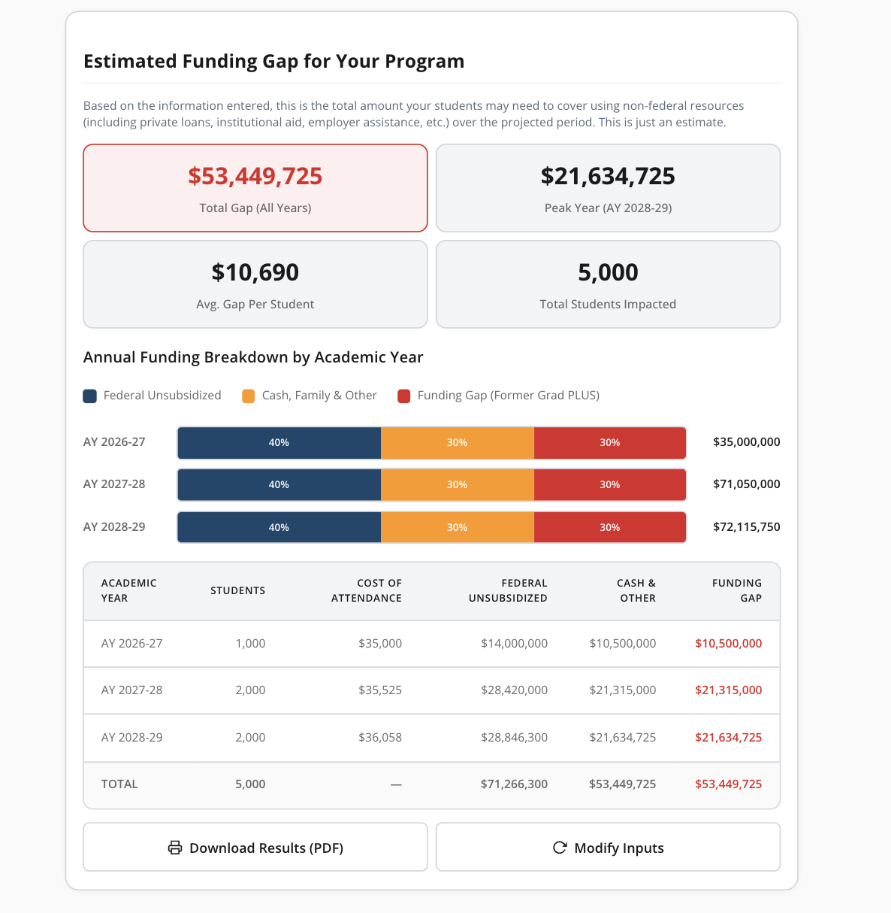
Now you can see the number you’re here for: your estimated funding gap. That’s the amount of Grad PLUS-backed funding that would no longer be available to new borrowers starting in 2026–2027, based on the assumptions you entered.
Why this matters: once you can see the gap, you can connect it to real choices: how much funding you’d need to replace to protect enrollment, how quickly you’d need to act, and which programs or cohorts are most exposed.
Don’t worry about getting it perfect on the first pass. Once you see your funding gap, try a few “what-if” scenarios: adjust enrollment, COA growth, or your aid mix to see how the gap changes. When you land on a version you want to share, save or print the results as a PDF, and grab screenshots of the key numbers, charts, or tables for your team.
About Ascent
Ascent is a mission-driven fintech company committed to redefining student lending through a focus on access, affordability, and lasting economic impact. Backed by institutional capital, we offer innovative loan options for college and career training programs, helping more students qualify, with or without a cosigner. But funding is just the start. From career readiness tools to financial wellness resources to over $330,000 in no-essay scholarships, everything we build is designed to turn education into real opportunity.
Learn more about how we’re working to increase student income by $10 billion by 2028 in our Impact Report.