-
 Does FAFSA® Cover Graduate School and Masters Programs?You're reaching the final year of college, and you couldn't be happier. You have already decided to continue your education by going to graduate school and are ready to embark on this new adventure. But as you look at the potential cost of graduate school, you wonder, "Does FAFSA cover graduate school? Is that a thing?" If you're wondering, "does FAFSA pay for graduate school?" this blog will review the ins and outs of federal aid for graduate school. Can you get financial aid for graduate school? The Free Application for Federal Student Aid (FAFSA®) covers graduate school, and if you're wondering, "Does FAFSA cover masters programs?" It does! Just like your undergraduate degree, when you apply for the FAFSA for graduate school, you may be eligible for federal grants, scholarships, and loans, including: Direct Unsubsidized Loans Direct PLUS Loans for Graduate or Professional Students Teacher Education Assistance for College and Higher Education (TEACH) Grants Federal Work-Study Federal Pell Grants Outside of the FAFSA, you may also explore other funding opportunities, such as: Organization grants: There could be many industry-specific grants in your prospective field. Fellowships: In exchange for research activities, private organizations, government organizations, and schools may have fellowships based on your field of study and G.P.A. Employer Tuition Assistance: Some employers will pay or even reimburse some of the tuition for grad school. Scholarships: This is a traditional option available to graduate students. You can research scholarships on academic excellence, majors, and cultural diversity. Assistantships: Some schools have living stipends or even waive tuition for students in a specific trade. Military Aid: The GI Bill may help you pay for graduate school if you served in the military. Depending on where and when you did, you could also be eligible for the Iraq & Afghanistan Service Grant. How to fill out the FAFSA for graduate school Now that you know the answer to does FAFSA pay for graduate school, you're probably wondering how to fill out the application online. The submission process is almost the same for graduate students as for undergrad students. There is just one key difference. You're now considered independent. When you (and probably your parents) first filled out your FAFSA for your undergrad degree, you identified as a dependent. As a result, you submitted your parents’ financial information. Now that you're a graduate student, you'll need to apply independently and submit the following on your own: Tax return information Account balances for your bank or credit union and investment accounts if you have any Your social security number Your Federal Student Aid (F.S.A.) I.D. It can take less than an hour to complete the FAFSA if you have all the documentation handy. How much does FAFSA cover for grad school? How much FAFSA covers for graduate school depends on when you submit your application and what you may be eligible to receive. Grants and scholarships are awarded on a first-come-first-serve basis. When you submit your FAFSA and what funds are available at that time will determine how much aid you can expect to receive. When it comes to Direct Unsubsidized Loans, you'll get up to $20,500 a year. Remember that since you are applying as a dependent student, you are not eligible for the Direct PLUS loan. What is the Deadline for FAFSA? The deadline for FAFSA is the same regardless of whether you're an undergrad or graduate student is June 30th. The deadline stays the same year by year, so submitting your application as early as possible is best. As we've said before, the earlier you submit your application, the more money you could receive via scholarships and grants. Other financial aid options for grad students Don't worry if you've filled out your FAFSA, tried all the other options listed above, and still need help. There are some options to consider. Private graduate school loans can help you bridge the financial gap in your expenses and can help you pay for school.
 -
 The Different Types of Financial Aid Explained: Loans, Grants, & Work-Study ProgramsTypes of Financial Aid Explained: Learn about the different types of financial aid available for students, including loans, grants, and work-study programs.
 -
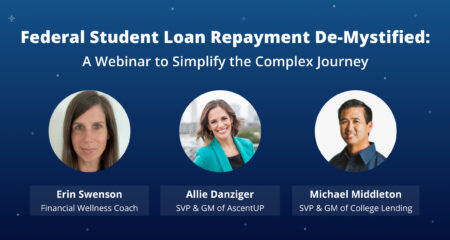 Confused about Federal Student Loan Repayments? Questions from Students, Answers from AscentAscent hosted an engaging webinar to address what’s on many people’s minds - federal student loan repayment. We know that embarking on this journey can be overwhelming and you're not alone. According to NerdWallet, “nearly 44 million borrowers with student loans” are entering repayment. We're committed to supporting individuals every step of the way. Our recent webinar, 'Federal Student Loan Repayment De-Mystified,' covered several topics ranging from how to prepare for repayment to understanding your repayment plan and exploring the invaluable resources available for those making budget adjustments. We want to offer resources and address some important audience questions we didn’t have time to cover and provide guidance and support on this complex topic. There are some great options for student loan repayment. What are the potential downsides to an Income Driven Repayment plan (IDR)? Income Driven Repayment (IDR) plans may be a good option for students that are unable to make their required payments under a standard, graduated or extended repayment plan, have low income or are enrolled in the Public Service Loan Forgiveness program, among other reasons. However, it is not always the best option for all students. Some of the disadvantages of IDR's include: You might not qualify for a lower payment than under a standard repayment plan Depending on which IDR plan, loan balances may increase as well as total cost of the loan due to unpaid interest It will generally take longer to fully repay the debt obligation Monthly payments may increase as your income increases There may be tax consequences for forgiven loan balances, and you may want to consult a tax professional What if my monthly payment is too high? How can I reduce this to a manageable amount? According to StudentAid.gov, “Most federal student loans are eligible for at least one income-driven repayment plan. If your income is low enough, your payment could be as low as $0 per month.” Start by exploring the new SAVE plan and use the Loan Simulator. This tool will help you explore repayment options that fit your needs. You can also reach out to your Loan Servicer to explore options for reducing your monthly payment. To find your Loan Servicer: Log into StudentAid.gov, view your Dashboard and access their information on the right-hand side panel. What is PSLF and how can I qualify? The Public Service Loan Forgiveness is a program for individuals employed by a government or non-profit organization that forgives the remaining balance on your direct loans: If you are working full time for an eligible employer After you’ve made the equivalent of 120 qualifying monthly payments under an accepted repayment plan The PSLF Help Tool is a great place to start and will help you: Search for qualifying employers List what actions you may need to take to become eligible Generate a PSLF form (tip: You must complete the form in a single session) Need more info? Check out this helpful FAQ about PSLF What types of student loan repayment options are there for Parent Plus Loans? Parent PLUS borrowers are eligible for the following repayment plans: Standard Repayment Plan Graduated Repayment Plan Extended Repayment Plan According to StudentAid.gov, “Parent borrowers can become eligible for an additional repayment plan—the Income-Contingent Repayment Plan—by consolidating their parent PLUS loans into a Direct Consolidation Loan.” If you have concerns about making payments, reach out to your Loan Servicer to discuss your options. Need more info? Check out these Parent Plus FAQs The conversation is far from over The conversation is far from over. It's ever evolving, and we recognize the importance of this topic for enrolled and unenrolled students, graduates and cosigners. We're dedicated to delving deeper and bringing more insights, advice, and conversations in the coming weeks. Stay tuned and keep sharing your questions, concerns, and personal experiences as it helps shape these discussions and strengthens our Ascent community.
 -
 Ask Ascent: From Internship to Full-Time RoleInternships offer students the chance to gain real-world experiences and grow their professional development skills. Internships may have the potential to lead to full-time roles, which can be a smooth transition for students as they enter the workforce. At Ascent, we are proud to onboard, train, and support interns as they take what they learn in the classroom and apply it to the workplace. We talked with a few team members who first joined the team as interns to learn more about their journey from internship to full-time role. Continue reading for more on the projects they worked on and the advice they would give to other students on the job or internship hunt. How did you two hear about Ascent as an intern opportunity? Jen: I was a newly transferred junior attending SDSU. The internships at Ascent were recommended to me by another SDSU student who was an Ascent intern at the time. Abigail: I became aware of Ascent’s internship opportunity via Handshake, an intern and job-hunting platform. I was in the application process for several different marketing internships, but I resonated with Ascent’s mission, and it struck a chord with me as someone who also felt lost navigating financial aid and loan borrowing. What role were you hired to do? Jen: My internship role here at Ascent consisted of a variety of experiences. Originally, I was a marketing intern working under our Marketing Operations Specialist at the time. I spent time supporting and coordinating various marketing campaigns including email, social media, content creation, and direct consumer marketing strategies. Abigail: My role as a marketing intern focused on content creation, social media, email campaigns, and blog posts. Today, my role as a marketing coordinator will work a lot more with engagement. I will be focusing on our email strategy and customer lifecycle. This includes ways to better connect with students and learn about the challenges they face. How long was your internship at Ascent? Jen: My internship lasted a little over a year, from March 2021 to May 2022. This would have been over my junior and senior year of college. Abigail: I was able to remain an intern at Ascent for over two years! Around the one-year mark, I was promoted to lead marketing intern and received a raise. Describe your team and the people you worked closely with on different projects. Jen: My teams were awesome! I met a ton of people because I was able to branch out and experience tons of different marketing initiatives. I was working on real projects that had a positive impact on the company, and I was able to test out different areas I was interested in. My age and student experience were celebrated as Ascent and my teams were eager to listen to my college and financial experiences. Everyone around me was excited to see me grow and happy to teach me new skills. Abigail: Since starting at Ascent, I have worked with nearly every team and department in some way or another. Currently, I work with our engagement team, and I love that we spend our time trying to find new ways to personally connect with our students and borrowers. My direct manager is Joanna, and she walks with me every step of the way. She has been a mentor and advocate for me since my very first day. What was your overall impression of company culture at Ascent? Jen: I was originally nervous about working for a loan company because I had little knowledge of the industry, but the previous intern who recommended the position spoke incredibly highly of Ascent. Once I started the interview process, everything fell into place. It was a perfect match and exactly what I was looking for in an internship. Abigail: I was concerned being the youngest person at the company would hinder my experience, but it became clear interns were seen as a valuable resource. It’s difficult being a full-time student during your internship experience, but Ascent was understanding and invested in my success as both an intern and student. What are you looking forward to the most in a full-time role at Ascent? Jen: I’m excited to continue my work with an incredible supervisor and experience a new position at Ascent that I was able to make my own. Abigail: With this new role I will be getting more involved in different projects and can fully focus on my work. Previously, I was trying to navigate being a student and employee. While working as an intern I would sometimes miss out on big picture projects or meetings due to classes or studying. Do you have any tips for other students searching for their dream internship that could turn into a full-time role? Jen: Take the initiative! There are tons of advantages to being a student. You’re able to find organizations that match your interests and ambitions while networking with like-minded individuals and alumni. During your internship, your chances of obtaining a full-time role will be impacted by building relationships with coworkers. They will be your supporters and advocates if you’re moved into a full-time role. Abigail: Internship and job-hunting can be exhausting, but the next application could be the one that propels you to your dream internship. If you’re an intern looking to score a full-time role, don’t be afraid to ask questions and explore different opportunities. While it’s important to show up and meet expectations, you also need to take time to decide if you like your role. I made sure to ask for more opportunities from my manager until I found my current role that fits my strengths and individuality.
 -
 What Will Make the Biggest Impact on Your Financial FutureTake the stress out of financial planning for college students with these five key steps.
 -
 6 Tips to Research & Apply for a Private Student LoanPrivate student loans can be a daunting task, here's how students can research and apply for a private student loan.
 -
 How to Qualify for Student Loans & Eligibility RequirementsConfused about private student loans? Learn how to qualify for private student loans and other eligibility requirements in this blog.
 -
 How to Get a Student LoanThere are several ways to get student loans, with a cosigner or without. Read how to get a student loan here to learn more.
 -
 A Guide to Filing Taxes as a College StudentAs scary as the word "taxes" may sound, it’s never too early for you to learn to do your own taxes, and you might even get some extra dollars in your pocket.
 -
 What I've Learned in CollegeCollege has been some of the best few years of my life and I've learned a lot along the way working toward my own success.
 -
 A Q&A Interview with Cruz SanchezEveryone’s path to a career they love looks different.
Tips to save
Ways to earn
Your Ultimate Guide to College Funding
Discover interactive tools, expert insights, and real-world strategies to help you pay for college with confidence.