-
 Ascent Recognized as One of Southern California's Best Places to WorkWe’re proud to share that Ascent has been recognized as one of Southern California’s Best Places to Work by Best Companies Group, an independent organization that honors companies creating strong workplace experiences for their teams. Best Places to Work SoCal is a research-driven program from Best Companies Group that reviews participating companies’ practices, programs, and benefits, then gathers employee feedback about their workplace experience. Companies that meet the program’s criteria are named among the Best Places to Work SoCal. For Ascent, this recognition reflects more than our benefits or programs. It reflects the people who make our work meaningful every day. At Ascent, we’re focused on building a workplace where people feel supported, trusted, and able to grow. Our mission is to help students access education and move toward academic and economic success, and we know that work starts with our own team. When employees feel valued and connected to the work they do, they’re better equipped to make a meaningful impact. Our team is curious, collaborative, and open to new ideas. Leaders encourage learning, create space for feedback, and support career growth across the company. We believe great ideas can come from anywhere, and we work to make sure employees feel heard, included, and empowered to contribute. Supporting employees means supporting the whole person. Ascent offers flexible and hybrid work options, generous PTO and leave policies, paid parental leave, wellness support, continuing education opportunities, and a 401(k) match. These benefits are designed to help team members care for themselves, grow professionally, and build sustainable careers. Recognition is also part of how we show appreciation. Through programs like Cosmic Kudos, professional development opportunities, and company-wide celebrations, Ascent makes time to acknowledge the work happening across the team. It’s one way we help create a culture where people support each other, celebrate progress, and take pride in the impact they’re making. “We’re proud to have built a workplace where employees feel trusted, supported, and genuinely connected to the work they do,” said Emily Skoubo, Director of Human Resources at Ascent. “This recognition reflects the collaborative culture our team has created together and our continued focus on providing an environment where people can grow, contribute, and feel valued.” At its core, Ascent’s culture is people-first and purpose-driven. Team members support one another, celebrate wins together, and stay connected to a shared goal: helping students and families plan for, pay for, and succeed in school. That mix of mission, collaboration, and opportunity is what makes Ascent a great place to work. We’re grateful to every employee who helps shape that culture every day and proud of what we’ve built together. As Ascent continues to grow, we’ll keep investing in our people, strengthening our culture, and creating opportunities for employees to do meaningful work while building rewarding careers. Because when our people succeed, the students and families we serve benefit too.
 -
 What Happens If I Don't Pay My Student Loans?What happens when you default on your student loans? This question may arise in the minds of many borrowers, particularly during financially challenging times. Before accepting a college loan, it’s important to understand that neglecting student loan repayments can lead to consequences beyond immediate financial distress. These ramifications can influence your daily life and impact your financial health. This article will discuss the potential risks associated with defaulting on student loans and provide strategies and knowledge to help prevent them. A strong understanding of your contractual obligations and the resources to help you repay your loans successfully is the first step toward maintaining your financial health. The Importance of Paying Back Your Student Loans Student loans, like any other loan, represent a promise. You've borrowed money to fund your education and pledged to pay it back. When you honor this promise, it's a win-win situation. Your credit score remains robust, making future borrowing easier, and it showcases your financial responsibility. You're meeting your financial obligations to your lender by repaying your student loans. But what if things aren't going so smoothly? We know handling student loans with a cosigner or without can be tough. Life happens, work can be unpredictable, and balancing everything at once can feel like a juggling act. However, not paying student loans doesn't make these problems disappear. In fact, failing to pay back your student loans can make things much worse. The Impact of Not Paying Student Loans If you are in a financial bind and considering defaulting on your student loans, know there are resources available to help you navigate these waters. The last thing you want to do is make a financial decision that will impact your financial well-being for years to come. The Federal Student Aid website is a great place to start. It's packed with helpful resources to guide you on your repayment journey. Remember, it's all about taking it one step at a time. Below are some potential consequences borrowers may face for not paying back student loans. Legal Ramifications Defaulting on student loans can lead to serious legal and financial repercussions. If you fail to make your scheduled loan payments for at least 270 days, your federal student loans enter a state of default. This can trigger a series of consequences, including wage garnishment and withholding of tax refunds. Once your loan enters default, the entire unpaid balance and all accrued interest become due immediately—a process known as acceleration. The federal government can then garnish up to 15% of your disposable income without a court judgment. Additionally, your tax refunds and federal benefit payments may be garnished or withheld to repay your overdue student loan balances, a process known as Treasury Offset. Consequences can vary based on the type of student loan—federal or private—and the specific terms of your loan agreement. Therefore, it's crucial to understand your loan terms and seek advice from a financial advisor or legal professional if you struggle to make payments. Ascent has a library of financial wellness resources to help you understand your options regarding responsible borrowing. Negative Effects on Credit Score Your credit score might seem abstract, but it's a key player in your financial journey. This three-digit number can influence your ability to secure future loans, the interest rates you'll be offered, and even your eligibility for renting an apartment. If you cannot make student loan payments, it's important to know that this can lead to a dip in your credit score. Late or missed payments on your student loan can negatively impact your credit score. Furthermore, when your loan defaults, your credit report may reflect multiple missed payments, significantly lowering your credit score. Student loan repayment isn’t just about consequences, though. Making regular on-time payments on student loans will help you build and maintain a healthy credit score, setting you up for financial success in the future. Ineligibility for Federal Student Aid One of the lesser-known consequences of defaulting on your student loans is the potential ineligibility for further federal student aid. This could pose a significant barrier if you plan to return to school or pursue further education. You may put your grad school dreams on hold until your defaulted loans are resolved. The impact of not paying back your student loans can be severe and long-lasting. Failure to pay back your student loans and the impact this decision could have on your credit score may impact your future and financial health for years to come. The penalties associated with default can also result in hefty expenses, especially for borrowers who are already financially vulnerable. It's important to note that the consequences of defaulting on student loans can vary depending on several factors, including the type of loan, the duration of the default, and state laws. Therefore, it's crucial to understand the terms of your loan agreement and seek advice from your lender or a legal professional if you're struggling with repayment. Exploring Alternative Repayment Options If you're struggling to make student loan payments, it's important to know that alternative repayment options are available. These options can make your debt more manageable and help you avoid the negative consequences of defaulting on your loans. Loan Forgiveness Programs Loan forgiveness programs can be a lifeline for those struggling with student loan debt. These programs can eliminate part or all of your loan if you meet certain conditions. For instance, the U.S. Department of Education offers forgiveness and discharge programs for federal student loans. You may qualify to have some or all of your loans forgiven or discharged in certain situations, such as working in public service or in instances of total and permanent disability. Repayment Plans In addition to loan forgiveness programs, repayment plans can help make your monthly payments more manageable. Remember, the key is to take action and explore these options before your loans go into default. If you're unsure what steps to take, consider contacting your loan servicer or a financial advisor for guidance. Seeking Professional Help for Student Loan Repayment Navigating the complexities of student loan repayment can seem daunting, but remember, you're not alone. Professionals and resources are available to help you manage your student loan debt, understand the intricacies of your loans, explain your options like student loan forbearance or student loan deferment, and even negotiate with your lenders on your behalf. Learn More with Ascent At Ascent Funding, we're devoted to helping students and their families understand the ins and outs of student loans. Whether you're working to manage your student loan payments or simply eager to understand more about committing to a student loan, we have many resources tailored to your needs. No matter where you are in your journey—whether you are embarking on your college adventure or already addressing student loan repayment—explore our Financial Wellness Hub and find resources to guide your path to financial success for years to come. FAQ What are the Implications of Not Repaying My Student Loans? Deciding not to repay your student loans carries several severe legal and financial consequences. From a legal standpoint, your creditor could take action against you to recover the debt. This might take the form of wage garnishment, where a percentage of your earnings is automatically directed toward repaying the loan, or you may face a lawsuit. In some extreme federal student loan cases, the government can withhold your income tax refund or social security benefits. From a financial standpoint, defaulting on student loans can drastically lower your credit score. A lower credit score can lead to a series of negative outcomes. For instance, it can make it harder for you to secure loans or credit in the future, or you may be charged higher interest rates. It also makes it difficult for you to rent an apartment, get a cell phone plan, or even get a job, as some employers check credit scores. So, it's critical to understand that evading repayment of your student loans is not a sustainable strategy and can lead to significant challenges down the line. Will My Student Loans Automatically Disappear After 7 Years? Whether your student loans will drop off your credit report after a finite amount of time depends on the type of student loan and the statute of limitations for the state you live in. Private student loans have a statute of limitations ranging between three to ten years, depending on your state of residence. Federal student loans, however, do not have a statute of limitations, which means they can stay on your credit report indefinitely or until the loan is paid off. How Long Can I Go Without Making Payments on My Student Loans? The duration you can go without making payments on your student loans before defaulting depends on your loan type. For federal student loans, you're typically considered in default after you haven't made a payment for 270 days (approximately nine months). For private student loans, the time frame can vary significantly and depends on the terms set by your lender—it could be a much shorter period. However, missing even one payment can negatively impact your credit score. It can also lead to late fees and potentially accelerated repayment of the full loan amount. It's crucial to understand the consequences of not paying student loans and to take proactive measures to avoid default. If you're struggling to make payments, contact your loan servicer. They can provide information about deferment, forbearance, or income-driven repayment plans that could provide some temporary relief.
 -
 What Is the Minimum Credit Score Needed for Student Loans?As with all loan types, your credit score significantly impacts your eligibility for private student loans. Your credit score may also affect critical aspects of the loan, such as the total loan amount, interest rate, lender options, and repayment terms. But what is the necessary credit score for student loans? Read more to find out. Federal Student Loans vs Private Student Loans Credit Scores In most cases, your credit score can impact your approval for a loan, your interest rates and loan terms, and whether you need a cosigner. The credit score requirements of federal student loans and private student loans differ significantly, as do their benefits. Credit Requirements and Benefits of Federal Student Loans Federal loans, including Direct Subsidized Loans and Direct Unsubsidized Loans, do not have strict credit score requirements. Instead, federal loan eligibility is based primarily on financial need and enrollment status. Additionally, federal student loans do not require a cosigner. There are many benefits of federal student loans. Direct Subsidized Loans offer interest subsidies (meaning the government pays the interest on the loan) while the borrower is in school or during grace or deferment periods. Federal loans offer income-driven repayment plans that adjust monthly payments based on the borrower’s income. Public Service Loan Forgiveness is available for borrowers who have made the equivalent of 120 qualifying payments and work in public service jobs, such as working for government agencies or nonprofits. Federal loan borrowers facing financial challenges may also qualify for deferment or forbearance programs to reduce or postpone payments. Federal Loans have fixed interest rates that remain for the life of the loan, and these rates may be lower than those from private lenders. Federal student loans also have predictable, standard repayment plans, but many borrowers have the option of graduated or extended repayment plans. Credit Requirements and Benefits of Private Student Loans The credit score requirements of private student loans vary tremendously between providers, but most loan products require a certain credit score. Your credit score and history can impact the terms of your private loans, which is why private student loans often require cosigners. This is especially true for borrowers with low credit scores or minimal credit history. Private student loans may offer many benefits and include customizable features. They can have fixed interest rates, variable interest rates, or rates that change over time based on market conditions. Private lenders often provide greater flexibility in choosing repayment terms, allowing borrowers to customize repayment plans based on their situation. For example, Ascent has up to 40 repayment options–more than any other student loan–ranging from 5 to 20-year terms, depending on your program and the loan options. Additional benefits like zero fees, cash back at graduation, and automatic payment discounts are other common perks to look out for when evaluating lenders. Some private lenders (including Ascent) also offer cosigner release options, which will relieve cosigners from responsibility for the loan if the primary borrower meets certain criteria. Remember that loan terms, rates, and benefits will vary significantly between lenders and borrower qualifications, so it is important to do your research and find the best fit for your needs. Often, students may apply for a combination of federal and private student loans in order to cover the full cost of tuition expenses. Understanding Credit Score for Private Student Loans While every lender requires different credit score requirements for specific loans and terms, understanding the general credit ranges can help predict the type of loan and loan terms you will get based on your credit score. For example, FICO® scores are based on the credit score ranges below: Poor Credit: 300 to 579 Fair Credit: 580 to 669 Good Credit: 670 to 739 Very Good Credit: 740 to 799 Excellent Credit: 800 to 850  As with any type of credit-based loan, a higher credit score is generally a sign that the borrower may be more credit worthy, and therefore more likely to pay the loan back on time. This could have an impact on your eligibility or the loan terms you are offered. But, fear not,–there are options for aspiring borrowers with low credit scores or no credit history at all. If you are unable to qualify for a loan on your own, you can consider applying for a student loan with a cosigner. While many lenders do have a minimum credit score, these requirements will often vary based on the loan product, credit history, and whether you are applying with or without a cosigner. In many cases, the only way to find out how your credit score will impact your eligibility or interest rate is to apply. How to Find Out Your Credit Score for Student Loan Applications There are several ways to determine your credit score. The easiest option for many individuals is to obtain their credit score from major credit reporting agencies, including Equifax, Experian, or TransUnion. You are also entitled to one free credit report each year from AnnualCreditReport.com. Checking your credit report annually is a great way to keep track of your credit score and does not count as a hard inquiry against your credit profile. Some credit monitoring agencies also provide ongoing access to your credit score, and many banks and financial institutions also offer free access to credit scores through their online platforms. Some credit card statements also include your credit score. Many lenders will also allow you to check your rate without affecting your credit score in just minutes. This can be helpful if you are looking to get an idea of your prequalified rates or compare rates across different private lenders. Tips to Improve Your Credit Score for Student Loans Luckily, there are many ways to improve your credit score for student loans. Some of the most important strategies you can use include: Make timely payments on all your bills, credit cards, and loans. Reduce your credit card balances to keep your credit utilization rate (the ratio of your credit card balances to your credit limits) below 30% Check credit reports and dispute any errors. Only open new credit accounts after you have completed the student loan application process. Diversify your credit mix using various types of credit, including credit cards, installment loans, and retail accounts. Establish a good credit history if you have limited credit history. For example, opening a low interest credit card is a strategy that many college students use to start building credit early on. Getting Student Loans Without a Cosigner A cosigner agrees to share the obligation to repay the loan if the primary borrower is unable or unwilling to do so. Getting student loans without a cosigner can be challenging, especially if you have limited credit history or low credit scores. However, there are some strategies that you can use that will make it more likely. Build a positive credit history. Investigate multiple loan providers, both private and federal. Apply to lenders that consider other factors besides credit scores. Demonstrate stable income or employment. Apply for scholarships and grants. Even if you can qualify for a student loan without a cosigner, applying with a cosigner may help you qualify for a larger loan, lower interest rates, or better loan terms. Although cosigned loans are most common for students with poor credit or little credit history, there are options available for prospective students who do not have or want a cosigner. For example, Ascent offers credit-based and outcomes-based loans without a cosigner for eligible students. In addition to credit-friendly programs, some lenders may offer secured loans, where the borrower provides collateral, such as a savings account or real estate, to secure the loan. Secured loans can be a great option for students with low or no credit and are figuring out how to pay for college. If you do plan to apply with a cosigner, visit our blog for more tips on how to find a cosigner for your student loan. Learn More with Ascent Navigating the student loan application process can be challenging, and Ascent is committed to providing students and families with the financial resources needed to pursue their dreams. From financial wellness resources to our flexible college loans and undergraduate student loans, we are here to help students and their families make informed decisions about their future in college, and beyond. Credit Score for Private Student Loan FAQ Is it Hard to Get Approved for a Student Loan? The difficulty to get approved for a student loan depends on many factors. Borrowers with a high credit score and good credit history may find it easy to get approved for a low-interest rate loan with favorable terms. On the other hand, borrowers with poor credit scores or little credit history may struggle to get approved for a student loan, particularly if they do not qualify for federal student aid. Luckily, Ascent makes the application process as simple and easy as possible. What Disqualifies You from Getting a Student Loan? Different lenders will disqualify you from getting a student loan for different reasons. The good news is even if one disqualifies you, another may not. Some common reasons for disqualification may include: Defaulting on existing or previous student loans Exceeding borrowing limits Failure to meet satisfactory academic progress (SAP) requirements Conviction of drug offenses Filing for bankruptcy Failure to register for the Selective Service (the draft) Not being enrolled in an eligible program Outstanding refund owed on a federal grant Does Bad Credit Affect Getting Student Loans? Bad credit can have a tremendous impact your student loan application. Many lenders will not lend to you at all, and those that will lend to you, will often only do so if you agree to relatively unfavorable terms or to have a cosigner. Bad credit may decrease the total loan amount you are approved to borrow, and increase your interest rate.
 -
 How to Calculate Student Loan Interest: A Step-by-Step GuideUnderstanding how student loan interest works and how it's calculated can help you manage your debt more effectively–and potentially save you money. Staying informed and making smart decisions about your student loans can help you invest in your education without sacrificing your financial future. Key Takeaways Student loan interest is calculated daily and added to your balance monthly. Interest typically begins accruing upon disbursement. Calculate your student loan interest by finding the daily interest rate (annual interest rate divided by days in the year). Next, multiply your daily interest rate by your outstanding loan balance to determine how much interest accrues each day. Then multiply your daily interest accrual by the number of days in your billing cycle to determine your monthly interest charges. Capitalization occurs when unpaid interest is added to your principal balance. This makes your total debt bigger, so you’ll pay interest on a higher amount going forward. This typically happens after a deferment or grace period. There are two main types of interest rates: fixed and variable. Fixed rates remain the same, offering predictable payments. Variable rates fluctuate with the market, potentially affecting your monthly payment and total repayment amount. Understanding Student Loan Interest When you take out a student loan, you're not just borrowing the amount you need for school; you’re also agreeing to pay interest, a cost calculated as a percentage of the principal amount. Interest is essentially the price you pay for the opportunity to borrow the money. Understanding how interest is calculated on student loans is crucial for managing your debt and planning your financial future. Interest on student loans is typically calculated daily and added to your loan balance monthly. The amount of interest you owe depends on your loan's interest rate, the amount of your loan, the time it takes to repay it, and other loan terms. Generally, the longer you take to repay your loan, the more interest you'll pay. Types of Student Loan Interest The primary types of student loan interest are fixed and variable. Let’s take a deeper look at the two and how they differ. Fixed Interest Rate Loans Fixed interest rate loans have an interest rate that remains the same for the life of the loan. This means your monthly payments will be predictable, and you'll know exactly how much you'll pay over the loan term. Federal student loans typically have fixed interest rates, not based on credit score or financial history, but are set by law. Variable Interest Rate Loans Unlike fixed-interest rate loans, variable interest rates fluctuate over time to mirror market conditions. Variable interest rates are typically tied to a financial index and can rise or fall based on the current market interest rates. While variable rates are sometimes lower than fixed rates, they're also less predictable. If rates increase significantly, so could your monthly payment and total loan cost. Differentiating Principal and Interest Payments When you make a payment on your student loan, it's applied to both the principal and the interest. Initially, a large portion of your payment goes toward the interest. Over time, as the principal balance decreases, more of your payments are applied to the principal. Understanding this concept can help you make informed decisions about how to calculate interest on student loans and how extra payments or a different repayment plan might affect your total cost. Steps on How to Calculate Student Loan Interest Let’s start by breaking down the equation for calculating student loans. Interest = Principal Balance x Daily Interest Rate x Time Principal Balance: The initial amount borrowed on your student loan. Daily Interest Rate: Your annual interest rate is divided by the number of days in the year. Time: The number of days you want to calculate the interest. You can calculate the amount of interest that accrues on your loan by plugging these values into the equation. Continue reading for the steps on how to calculate student loans: 1. Find Your Daily Interest Rate The first step in calculating your student loan interest is to find your daily interest rate. This is your annual interest rate divided by the number of days in the year. For example, if your annual interest rate is 5%, your daily interest rate would be approximately 0.0137%. 2. Determine Daily Interest Accrual Charge Next, you'll need to determine how much interest accrues each day. You do this by multiplying your outstanding loan balance by your daily interest rate. For instance, if your loan balance is $20,000 and your daily interest rate is 0.0137%, you would accrue about $2.74 in interest per day. 3. Multiply by Days in Billing Cycle to Find Monthly Payment Finally, to find out how much interest you'll be charged in a month, multiply your daily interest accrual by the number of days in your billing cycle. Continuing with the previous example, if your billing cycle is 30 days, you would accrue about $82.20 in interest for that month. Tools and Resources for Calculating Student Loan Interest From college degree ROI calculators to federal loan simulators, there are plenty of tools and resources available to help you understand how to calculate student loan interest. These tools can provide a detailed explanation of your loan, including how much of your payments are towards interest versus the principal and how extra payments or a different repayment plan might affect your total cost. In addition to online calculators, your loan provider should give you detailed loan statements that break down your payments into principal and interest. Your provider should give you a clear picture of how your payments are applied and how much of your loan balance is still outstanding. If you’re unsure how to read your loan statement or have questions about your interest rate, don’t hesitate to reach out to your lender for assistance. What is Capitalization of Interest? When calculating your student loan interest, it's also important to understand the concept of capitalization. Capitalization is when any unpaid interest on your student loan is added to the principal balance. This can happen at certain times, like when your loan enters repayment or after a period of deferment or forbearance. When interest is capitalized, it increases the principal balance of your loan, which means you'll be paying interest on a larger amount. This can increase the total cost of your loan and make your monthly payments higher. This information can help you plan your payments and potentially save money in the long run. When Student Loan Interest Starts Interest on student loans typically starts accruing as soon as the loan is disbursed. This means that your loan could accumulate interest even while you’re still in school. However, with some types of loans, like subsidized federal loans, the government will pay the interest while you're in school, during the six-month grace period after you leave school, and during any periods of deferment. That’s why it is important to understand the difference between subsidized vs. unsubsidized loans. For unsubsidized loans, the interest starts accruing when the loan is disbursed. If you choose not to pay the interest while you're in school or during your grace period, it will be capitalized, or added to your principal balance, when you start repayment. The Importance of Understanding Student Loan Terms Understanding how student loan interest works is just one part of managing your student loans effectively. It's also important to know the terms of your loan agreement, including your repayment schedule, the consequences of missing a payment, and what options you have if you're struggling to make your payments. For example, many student loans offer deferment or forbearance options, which allow you to temporarily stop making payments or reduce your payment amount if you're facing financial hardship. However, interest may continue to accrue during these periods, which can increase the total cost of your loan. Learn More with Ascent At Ascent, we're committed to helping students and families navigate the world of college loans and make informed financial decisions. We offer a range of financial wellness resources to help you understand your loan options and manage your student loan debt effectively. Whether you're just starting your college journey or seeking graduate student loans to help you further your education, we're here to help you reach your academic and financial goals. FAQ How do you reduce the total interest paid on student loans? You can use several strategies to reduce the total interest paid on your student loans. One of the most effective ways is making a payment more than the minimum monthly amount. Paying above the minimum can help you reduce your principal balance faster, which means you'll be charged less interest over the life of the loan. Another strategy is to refinance your student loans. Refinancing involves taking out a new loan with a lower interest rate to pay off your existing loans. Refinancing can reduce your monthly payment and the total amount of interest you pay. However, refinancing isn't right for everyone, and it's important to consider the pros and cons before deciding. What happens if you don't make student loan payments? You could face serious consequences if you don’t make your student loan payments. Your loan could become delinquent, and if you continue to miss payments, it could go into default. This can damage your credit score, making it harder for you to get credit cards, auto loans, or mortgages in the future. In addition, if you default on federal student loans, the government can collect the debt, including garnishing your wages or withholding your tax refund. If you're struggling to make your student loan payments, it's important to reach out to your lender as soon as possible. They may be able to work with you to find a solution, such as changing your repayment plan, applying for deferment, or forbearance. Do student loans have interest? Yes, student loans do have interest. The interest rate can vary depending on the type of loan and the lender. By law, federal student loans have fixed interest rates, while private student loans can have either fixed or variable rates. The interest on your student loans can significantly affect the total cost of the loan, so it's important to understand how to calculate interest on student loans and consider the interest rate when choosing a loan.
 -
 Why You Should File the FAFSA® as Early as PossibleThe Free Application for Federal Student Aid, or FAFSA, is the first step in the application process for federal student aid, encompassing all federal loans. For students looking to secure financial aid for the upcoming school year, it can pay off to be proactive and file the FAFSA as early as possible. Read on to find out why, plus we'll review important FAFSA deadlines, eligibility requirements, and tips for a successful application process. 5 Benefits of Filing the FAFSA Early Filling out the FAFSA early maximizes your chances of securing the most possible federal aid. The sooner you apply, the sooner you’ll have a clear view of the bigger financial picture. This gives you more time to seek out alternative sources of funding—like private student loans—should federal aid not cover the full cost of your tuition and expenses. Those are just a few reasons to file the FAFSA as early as possible. Here’s the full list: 1. Maximize Financial Aid Opportunities Some federal student aid, namely grants and scholarships, areis awarded on a first-come, first-served basis. Completing the FAFSA early gives applicants the best chance of securing the maximum federal financial aid they may qualify for. 2. Access to State Grant Programs Not only is some federal aid granted on a first-come, first-served basis, but a portion of state aid is as well, especially state grant programs. Since many of these programs determine eligibility at least partially through the FAFSA, filing early may increase your eligibility for state grants and other state student aid. 3. Avoid Last-Minute Panic The college and student aid application processes can be stressful, especially when facing critical deadlines. Avoiding last-minute rushing gives you time to ensure your FAFSA submission is thorough and accurate. This can help curb your stress levels and ensure you can provide the most accurate information on the application. 4. Ease of Comparison Between Colleges The sooner you complete the FAFSA, the sooner you may receive your financial aid award letters. This can give you more time to carefully compare the aid packages offered by different colleges and make the best possible decision for your educational (and financial) future. 5. More Time to Pursue Other Forms of Financial Aid Submitting the FAFSA and getting your results as early as possible gives you more time to explore and pursue other financial aid options, such as scholarships and private grants. It also gives you more time to pursue private student loans as a supplemental option should federal aid leave a gap between funding and your total expenses. FAFSA Eligibility Requirements To qualify for federal student aid through the FAFSA, prospective students must meet the following general FAFSA eligibility requirements: A demonstration of financial need as determined by information provided in the FAFSA U.S. citizenship, U.S. national status, or eligible noncitizen status A valid Social Security Number, unless the applicant is a citizen of the Freely Associated States A high school diploma, GED, or other recognized ability-to-benefit alternative Enrollment (or acceptance for enrollment) in an eligible degree or certificate program Continued satisfactory academic progress In addition to the above, you’ll also have to consent to have your personal tax information transferred into the FAFSA form and sign a certification statement pertaining to your intended use of funds and qualification to obtain further education. For a visual aid on the information above, check out this FAFSA eligibility infographic. The Importance of Meeting FAFSA Deadlines Meeting FAFSA deadlines is critical for several reasons. First, it can help ensure that you receive the maximum federal financial aid you’re eligible for. Second, it can impact your ability to meet deadlines for state and institutional aid programs. Lastly, advanced planning can help your family plan for college funding and their anticipated contribution. Conversely, missing important FAFSA deadlines can have negative consequences. The pool of available funds you’re eligible to receive might be reduced, limiting financial aid options, and the disbursement of your financial aid may be delayed. Additionally, many aid programs have strict deadlines, leaving applicants who file late submissions ineligible for certain types of aid. With that in mind, here are some important FAFSA deadlines for the 2024-25 school year: December 31, 2023 – The 2024 FAFSA goes live; the earliest possible application date February 1, 2024 – The first state deadline for priority consideration (some states don’t offer priority consideration, and those that do have different dates) April 2, 2024 – The first state deadline for program consideration (all states have different dates) June 30/July 1, 2024 – The deadline for many states (most states set their deadline either at this point or before) June 30, 2025 – The last possible date a 2024 FAFSA can be submitted September 14, 2025 - The deadline for any corrections or updates to be submitted School deadlines – Each institution may have its deadline; check with the school you’re interested in attending The 2025-26 FAFSA form is scheduled for public release on or before December 1, 2024. Additional deadlines will be added as they are announced, so check back for updates. Although not ideal, there are still options if you submit the FAFSA late. However, it will limit your options considerably. According to StudentAid.gov, “some states and colleges continue to award aid to FAFSA latecomers.” Still, your odds of receiving aid become slim, and payouts are often lower. Contact the financial aid offices at schools you’re considering for assistance and information on their options for late submissions. Private scholarships, grants, and loans are one possibility to potentially replace federal or state aid for students who miss deadlines. Tips for a Successful FAFSA Application Completing the FAFSA can significantly impact the financial aid you’re eligible to receive. Here are some tips for a successful application. Gather the necessary documents and information immediately and keep them in a single, easily accessible location. This includes Social Security numbers, tax returns, tax forms (such as your W-2), and other financial records. Provide up-to-date and fully accurate information to increase approval chances and minimize delays or errors in the application process. Complete and submit the FAFSA as early as possible to maximize possible aid. Seek professional guidance from financial aid professionals or counselors if you are unsure about any aspect of the FAFSA. Keep track of all federal, state, and institutional application deadlines that apply to you, and make sure you meet them. Carefully review the confirmation page for accuracy and completeness after you submit the FAFSA and address any issues immediately. Update your FAFSA if your financial circumstances change significantly. Learn More with Ascent You deserve to achieve your academic dreams. But to do so, you must be able to fund them. Whether you’re looking for graduate or undergraduate student loans, Ascent is here to help with a range of options to finance your education, including cosigned student loans and no cosigner student loans. Visit our Bright Future Hub for more resources to help you succeed in college and beyond. FAQ Do you get more money from FAFSA if you apply early? You can often get more money from FAFSA if you apply early. There are a few reasons for this. You may be prioritized for the many federal, state, and institutional aid programs allocated on a first-come, first-served basis. You will also have more time to apply for scholarships, grants, and private student loans and to compare the financial aid packages offered by institutions you’re considering. Why is it best to file the FAFSA as early as possible? There are many reasons why it’s best to file the FAFSA as early as possible. Some of the most important include: Maximizing the financial aid opportunities available to you Maximizing access to state and institutional aid programs Receiving award notifications faster Having more time to make informed decisions about college acceptance and financial planning Maximizing the chances of taking part in the Federal Work-Study program Planning and comparing financial aid packages and eligibility as soon as possible Meeting institutional and state financial aid application deadlines Reducing stress and last-minute panic Minimizing the possibility of mistakes and errors that could negatively impact financial aid eligibility When should I fill out my FAFSA? You should fill out your FAFSA as soon as possible. The FAFSA for the 2024-25 school year is live and can be filled out anytime. Be aware that each state and institution will have its own FAFSA application deadlines, as will many private scholarships and grants. The last possible day to fill out the 2024-25 school year FAFSA is June 30, 2025.
 -
 Which Interest Rate Is Better for a Student Loan, Variable or Fixed?If you submitted the Free Application for Federal Student Aid (FAFSA) and are anticipating a gap between your covered financial aid and your tuition expenses, you’re not alone. Like many students and families in your situation, you’re likely exploring supplemental financing options to help you cover the rising costs of college. This is where options like scholarships and private student loans can come in handy. Understanding the different options for student loans can be a stressful, but important step as you prepare for your educational journey. One consideration you need to make when selecting a student loan is the interest rate. You can choose from two major types of interest rates: fixed or variable. Whether a student loan with a fixed or variable interest rate is a better choice depends on many factors, including your financial circumstances, educational goals, and loan terms. Read on to understand how student loans work and the differences between fixed and variable interest rate student loans. What Is a Fixed Rate Student Loan? A fixed rate student loan is a type of student loan with an interest rate that remains the same for the duration of the loan. The payment due on a fixed rate student loan will not change over the life of the loan. Fixed rate loans can help protect borrowers from increases in market interest rates that could otherwise cause payments to fluctuate. Fixed rate student loans can cover some education-related expenses, including tuition, fees, housing, textbooks, and other educational necessities. Fixed rate loans can apply to undergraduate, graduate, and professional degrees. Typically, repayment on a fixed rate student loan begins once the student completes their degree program, and repayment is done through installments over a fixed number of years. Many lenders offer flexible repayment options, so be sure to compare lenders while you are doing your research. Pros and Cons of Fixed Rate Student Loans There are many advantages of fixed rate student loans, including: Stability and predictability of monthly payments. The ability to accurately and confidently budget your future payments. Protection for borrowers from fluctuations and increases in market interest rates. Knowledge of the total cost of the loan from when it is signed. A potentially lower overall cost if interest rates rise significantly over time. High desirability for risk-averse borrowers. On the other hand, there are also some disadvantages of fixed rate loans, those include: Likely higher initial interest rates. Likely higher initial loan payments. No benefits or cost savings if interest rates go down. Lower flexibility than variable rate loans. Potentially higher overall loan costs when market interest rates remain low over time. The loan may not reflect future economic conditions or market interest rates. What Is a Variable Student Loan? Also known as an adjustable-rate student loan, a variable student loan has an interest rate that can periodically change. In most circumstances, changes in variable rate student loans are caused by updates to a specified financial index. The terms of your loan will determine how often the interest rate may change, whether annually, semi-annually, or monthly. Due to changing interest rates, the payments on a variable rate student loan may fluctuate significantly over the life of the loan. Variable rate loans expose borrowers to fluctuations in market interest rates. Like fixed rate student loans, variable rate loans can be used to pay expenses for undergraduate, graduate, and professional degree programs and for education-related expenses, such as tuition, fees, room and board, textbooks, and other necessities. Repayment for variable rate student loans typically begins after the borrower is no longer enrolled in their degree program unless deferred for some reason, such as entering a new degree program. Repayment takes place over a set time through installments. Like fixed rate loans, multiple student loans can be consolidated into a single variable rate student loan. Pros and Cons of Variable-Rate Student Loans There are many advantages of variable rate student loans, including Likely lower initial interest rates. Likely lower initial loan payments. May decrease interest rates and loan payments over time. High cost-effectiveness in low interest rate environments. Potentially lower overall loan costs in low interest rate environments. Greater flexibility than fixed rate student loans. May better reflect future economic conditions or market interest rates. On the other hand, some disadvantages of variable rate student loans include: Expose borrowers to interest rate volatility. Eliminate the ability to accurately budget for more than a short period in the future. Potentially higher interest rates. Potentially higher monthly payments. Potentially higher overall loan costs if interest rates rise over time. Less desirable for risk-averse borrowers. May expose borrowers to greater refinancing risks. Dependency on market conditions. Uncertainty of the total cost of the loan until it is paid in full. Do not protect borrowers from fluctuations and increases in market interest rates. Factors to Consider When Choosing Between Fixed vs. Variable Rate Student Loans Many factors must be considered when choosing between a fixed rate vs variable rate student loan. Here are some of the primary factors you should evaluate: The Interest Rate Outlook: If interest rates are expected to remain low or increase gradually over the life of the loan, variable rate loans are often more desirable, and vice versa. Risk Tolerance: If you prefer stability, accurate planning, and low risk fixed rate loans are a better choice. If you are willing to accept some risk of paying more under certain market conditions in order to potentially pay less initially, variable rate loans might be a better choice. Loan Repayment Timeline: The shorter the loan repayment time, the less likely you are to experience significant interest rate changes. Loan Terms and Conditions: Be sure to carefully review the terms and conditions of each loan you are considering, including any and all rate caps or limits on variable rate adjustments. Overall Financial Goals and Stability: You should consider your financial priorities, such as a consistent monthly payments, minimizing risk, paying the least possible amount, projected salary, and much more. Should I Get a Fixed or Variable Rate Student Loan? Deciding on what type of loan to apply for can be challenging. Unfortunately, unless you can predict the future, it is impossible to know whether a fixed or variable student loan will be the right choice for you. However, making an informed decision about the best decision for your situation is possible. The first thing to consider are your loan options based on income, credit score, and other eligibility criteria. You may only get approved for certain loans depending on your credit score and other factors. You will need to compare all the terms and conditions of the specific loans to decide on the right one for you. When comparing fixed vs. variable rate student loans, you must balance many factors and consider your circumstances and preferences. For example, if you are uncomfortable with risk, a variable rate loan will probably not appeal to you. On the other hand, if the potential to save money over the long term is worth some risk to you, a variable rate loan might be ideal. If you anticipate your salary will remain relatively stable over time, a fixed rate loan might be more advantageous. For a better understanding of your potential rates and repayment options, it can be helpful to review some hypothetical APR and repayment examples. If you are ready to view your personalized rate, you can check your rate in minutes without impacting your credit score. Learn More with Ascent Choosing the right student loan is a major decision that will impact your finances during and after college. Knowledge is power, so research which loan type is best for your unique circumstances. Whether you are looking for more information on how to get a student loan or comparing undergraduate student loans, Ascent is here to provide various financial wellness resources for students and families. If you need an additional financial boost to help cover your tuition expenses, we offer several loan types to meet your needs including cosigned student loans and no cosigner student loans. We look forward to helping you take the next step toward pursuing your goal in college, and beyond. Fixed Rate vs Variable Rate Student Loan FAQs Can I Change my Student Loan from Variable to Fixed? In many cases (but not all), you can change your student loan from variable to fixed if you meet certain criteria. You can do so by consolidating multiple student loans into a single fixed rate student loan or by refinancing the loan. Whether or not these options are available to you, as well as the specific terms that are available to you, will depend on several factors, including the type of student loans you have, the policies of the lender or loan servicer, the terms of your loan, and your creditworthiness and repayment history. Can you Refinance on a Fixed Loan? It may be possible to refinance a fixed rate student loan. You will typically have to obtain a new loan with different terms, including a new interest rate. Whether you can refinance a fixed rate student loan depends on several factors, including the loan type, the lender’s policies, and your financial situation. It may also be possible for you to consolidate your fixed rate student loans with other student loans to form a new, single student loan.
 -
 Graduate PLUS Loans: Your Comprehensive GuideDiving into advanced education is an exciting chapter in anyone's life. It's a time of personal growth, career development, and pursuing passions. But the financial side of this journey can sometimes feel overwhelming. That's where Direct PLUS or Grad PLUS Loans come in. These college loans are designed to support graduate and professional students pursuing higher education. In this guide, we'll learn about Grad PLUS Loans and explore their features, benefits, and how they may fit into your financial strategy for an advanced degree. Key Takeaways The passage of the “Big Beautiful Bill” (OBBBA) eliminates Grad PLUS loans for new borrowers after July 1, 2026. Grad PLUS Loans are federal loans for graduate and professional students that can cover the full cost of attendance—including tuition, housing, and other expenses—once other federal loan options have been exhausted. Eligibility for Grad PLUS Loans requires a credit check, enrollment at least half-time in a qualifying program, and meeting federal student aid requirements. Students with adverse credit may still qualify with a cosigner or extenuating circumstances. Grad PLUS Loans offer fixed rates and borrower protections, but private graduate loans may offer unique benefits or more competitive interest rates for borrowers with strong credit. Repayment typically begins six months after graduation or dropping below half-time. Interest accrues during this grace period, so it pays to understand how capitalization works and whether making early payments is worth it. What is a Grad PLUS Loan? A Grad PLUS Loan is a federal loan that can help cover some school costs for those pursuing advanced graduate degrees. What sets Grad PLUS Loans apart from other student loans is their ability to cover the total cost of attendance. Beyond just tuition, these loans can also apply to books, housing, and other education-related expenses, filling in the financial gaps where other types of aid may fall short. Graduate PLUS Loans are specifically available to graduate and professional students who have exhausted their eligibility for Direct Subsidized or Unsubsidized Loans. Grad PLUS loans are made available by the U.S. Department of Education and have a fixed interest rate that is set annually. Interest rates for Grad PLUS Loans may be higher than other federal student loans, so be sure to factor this in when planning repayment. Eligibility of Grad PLUS Loans While Grad PLUS Loans offer valuable financial support for graduate and professional students, they are not available to just any student. To qualify for Grad PLUS Loans, you must meet certain criteria: Enrollment Status: You must be a graduate or professional student enrolled at least half-time in a program leading to a graduate or professional degree or certificate at a school participating in the Direct Loan Program. General Eligibility for Federal Student Aid: Like other federal student loans, you need to meet the general eligibility requirements for federal student aid. This includes being a U.S. citizen or eligible non-citizen, having a valid Social Security number, maintaining satisfactory academic progress, and not defaulting on federal student loans. Satisfactory Credit History: Graduate PLUS Loans require a satisfactory credit history. While you are not required to meet a specific credit score threshold, having an adverse credit history may affect your eligibility. An adverse credit history means you’ve experienced certain negative credit events, such as bankruptcy, foreclosure, or defaulted loans. If you have an adverse credit history, you may still be eligible for a student loan with a cosigner. You may also be able to demonstrate extenuating circumstances. If you’re looking for a Ph.D. student loan or loan for your MBA, Grad PLUS Loans can be an option to cover the full cost of attendance for your graduate or professional studies. However, if you do not qualify for Grad PLUS loans or find that federal loans do not cover your full tuition expenses, you can consider private graduate student loans to help supplement this gap.  Key Features of a Grad PLUS Loan Grad PLUS Loans are designed with the students’ best interests in mind, offering financial support and protections to make pursuing higher education more attainable and manageable. Before deciding, it's essential to understand all aspects of these loans and consider how they align with your unique financial needs and academic goals. Here are several of the key features of these types of loans: Loan Limits Grad PLUS Loans stand out for their flexible loan limits. Unlike other federal loans, which have set annual and lifetime limits, the Grad PLUS Loan is designed to cover the full cost of attendance. This means they can cover everything from tuition and books to housing and other education-related expenses, making them a particularly beneficial option for programs with high tuition costs. Interest Rates Interest rates can make a big difference in the total cost of a loan. With Grad PLUS Loans, you don't have to worry about fluctuating rates. Grad PLUS Loans offer fixed interest rates, which means the rate you get when you take out the loan won't change over the life of the loan. The stability of the Grad PLUS loan can make it easier to plan for your loan repayment. Borrower Protections Life can be unpredictable. Graduate PLUS Loans come with borrower protections, providing a safety net during challenging times. These protections include options for loan deferment, forbearance, and access to income-driven repayment plans. These options can provide much-needed flexibility when dealing with financial hardship or changes in income. Application and Repayment of Grad PLUS Loans Applying for a Grad PLUS Loan is a straightforward process, like other types of Federal Aid: 1. Complete the FAFSA: You can start the process by filling out the Free Application for Federal Student Aid (FAFSA). This form determines your eligibility for federal aid, including Grad PLUS Loans. 2. Submit the Direct PLUS Loan Application: After completing the FAFSA, proceed to the Direct PLUS Loan Application. This application is specific to the Grad PLUS Loan and provides information about your school, desired loan amount, and authorizing a credit check. 3. Credit Check and Eligibility: Unlike other federal loans, Grad PLUS Loans require a credit check to assess your creditworthiness. An adverse credit history may affect your eligibility, but you can still qualify by obtaining an endorser or documenting extenuating circumstances to the U.S. Department of Education. 4. Loan Approval and Award Letter: Once approved for the Grad PLUS Loan, your school's financial aid office will send you an award letter. This letter outlines the loan amount and provides instructions for accepting or declining the loan. Repayment of Grad PLUS Loans As you progress through your academic journey, understanding the repayment process for Grad PLUS Loans is crucial for your financial success. Here's a breakdown of key points to keep in mind: Grace Period: Repayment for Graduate PLUS Loans typically begins six months after you graduate, leave school, or drop below half-time enrollment. During this grace period, you have time to organize your finances and start earning an income before making payments. Interest during the Grace Period: It's essential to be aware that interest continues to accrue on the loan during the grace period. If you defer payments, the accrued interest will be added to the loan balance (capitalized) when repayment begins. Repayment Options: During the grace period, you can make interest-only payments or defer your payments. Considering your financial situation and goals will help you decide on the best repayment option for your circumstances. Grad PLUS Loans Compared to Other Options Grad PLUS Loans are a great resource, but they are just one of the financial aid options available. It's important to consider all your options and choose the best fit for your needs. Federal Loan Options vs. Grad PLUS Loans Federal loans, such as Direct Unsubsidized Loans and Direct Subsidized Loans, are often the first stop for many students. These loans typically offer lower interest rates than Grad PLUS Loans, which can result in lower overall costs. However, they also have lower loan limits, which may only cover part of the cost of attendance for some programs. This is where Grad PLUS Loans can step in to fill the gap. Private Student Loans vs. Grad PLUS Loans Private student loans are another option to consider if you want to close the gap between your federal loan coverage and your tuition costs. These loans can offer competitive interest rates (especially for borrowers with strong credit), flexible repayment terms, and additional benefits not offered with federal loans. At Ascent, we are proud to offer over 40 repayment options–more than any other lender–in addition to perks like 1% cash back at graduation, dedicated U.S.-based customer service, and access to career coaching resources and internship support. The Importance of Financial Literacy and Loan Repayment Financial literacy plays a vital role in the lives of students taking on student loans. As you embark on your educational journey, it’s important to equip yourself with the knowledge and understanding of various financial concepts related to borrowing and repaying loans. Being financially literate means comprehending the terms and conditions of your loans, the impact of interest on your total repayment amount, and the array of repayment options available to you. Financial wellness is important to Ascent, which is why our borrowers have access to extensive financial literacy throughout their application and once they are a borrower, to ensure students (and cosigners) understand the responsibilities of borrowing money to pay for college. Learn More with Ascent At Ascent, we are committed to helping students navigate the financial aspects of their educational journey. Whether you want to learn the basics of student loans or explore options for graduate student loans, we provide the necessary resources and support. Explore our financial wellness resources or contact us to learn more about Ascent’s graduate student loan options today. FAQ How Much Can You Borrow with Grad PLUS? One of the standout features of Grad PLUS Loans is their flexible loan limits. You can borrow up to the full cost of attendance minus any other financial aid received. This includes tuition, books, housing, and other education-related expenses. This flexibility can make Grad PLUS Loans a valuable resource for funding your education. What is the Difference Between a PLUS Loan and a Grad PLUS Loan? While PLUS Loans and Grad PLUS Loans are part of the federal loan program, the main difference is who can borrow the money. PLUS Loans are available to parents of dependent undergraduate students, while Grad PLUS Loans are designed for graduate and professional students. Do Grad PLUS Loans Get Forgiven? Yes, Grad PLUS Loans are eligible for certain forgiveness programs. For example, if you work in public service, you may be eligible for Public Service Loan Forgiveness. Grad PLUS Loans are also eligible for income-driven repayment plans, which cap your monthly payments at a percentage of your income and can lead to loan forgiveness after a certain period.
 -
 How Much College Aid Are Students Missing Out On?How Much College Aid Are Students Leaving on the Table?
 -
 4 Ways Parents Can Help Young Adults Avoid Overpaying for CollegeSending your child to college is a major milestone, and one that can have a big impact on your family's finances. Whether you're exploring undergraduate student loans or other funding options, understanding the full cost is essential. With the rising cost of college, many students may be wondering if they can afford a college education and whether they are making the right financial choices along the way. As a parent, you can play a pivotal role in supporting your child through this journey, especially when it comes to offering financial guidance. Here are some valuable tips you can share with your child to help them avoid overpaying for college and set them up for future success. Budget for expenses beyond tuition Tuition is typically the first thing most people think of when considering the cost of college, but college expenses go far beyond just that. Additional expenses like meal plans, transportation, books, living arrangements, and spending money can add up quickly, and must be factored into budget planning. Understanding how to budget can help you and your child when discussing different types of financial aid - such as scholarships, grants, and student loans - they’ll use to pay for college. Many forms of financial aid can be applied beyond tuition, while other forms are paid to the schools directly and may not be enough to cover total tuition and lifestyle expenses. Teaching your child how to budget can help them plan out monthly expenses and avoid spending more money than they have available. Most importantly, if your child plans to take out financial aid, having an accurate picture of their total expenses will help ensure they do not overborrow in student loans. Explore and pursue scholarship opportunities Scholarships are a great place to begin looking for college financial support because, unlike private student loans, they don’t need to be paid back. Thousands of scholarships are available every year including from colleges, non-profits, employers, private organizations, and religious or social groups. Scholarships can be merit-based, need-based, or set aside for a particular group of people such as women and military families. Finding these scholarships can take time, but there are several resources to help you and your child find scholarships including online scholarship directories, college financial aid offices, high school counselors, foundation or organization websites, employers, or your state’s grant agency. If your child is planning to apply for scholarships, help them research early and check the deadline and requirements for each application, as they can differ. There is no limit to how many scholarships a student can apply to, and some scholarships may even extend eligibility to parents. Remember: every dollar received in scholarships is a dollar saved toward paying for college. [cross_promotion_banner] Put in the time to fully understand loan options Ensuring your child completes the FAFSA is the first step to supporting them in securing financial aid. Once you know how much federal financial aid your child qualifies for, you can better support and plan for any gaps between their expected expenses and the federal aid available to them. Knowing the differences between federal and private student loans can also help educate them on supplemental student loan options, if needed. Some private student loans offer perks like flexible repayment terms, access to college and career coaching, and even cash back at graduation, so it can pay to do your research. Understanding the total amount they will need to borrow–and be responsible for paying back–is critical before applying for any loan. As you and your child consider colleges and loan options, also encourage them to think about their expected salary and how much they’ll be able to afford in monthly loan payments post-graduation. Using a college ROI calculator can help them make informed choices about their major or school selection based on their expected income after graduation. Ascent also offers a variety of flexible loan options you can explore, including student loans with no cosigner, parent loans, and cosigned student loans. Improve your financial literacy (and your child’s) Preparing for college is an exciting time for both you and your child. It’s also a great opportunity to learn alongside them and improve your own financial literacy while helping them succeed. Learning how to budget responsibly to understanding how factors like credit score and interest rates can impact personal finances are invaluable concepts when it comes to avoiding or taking on debt responsibly and saving for the future. It’s never too early to teach your kids (or yourself) about the importance of making informed financial decisions. There is a plethora of free financial wellness resources, loan counseling, and financial aid guides to help parents and students unpack everything they need to know about paying for college, and making smart financial decisions in general. Investing in your child by facilitating open dialogue around finances and the importance of planning early can help ensure they do not overpay for college and set them up for future success.
 -
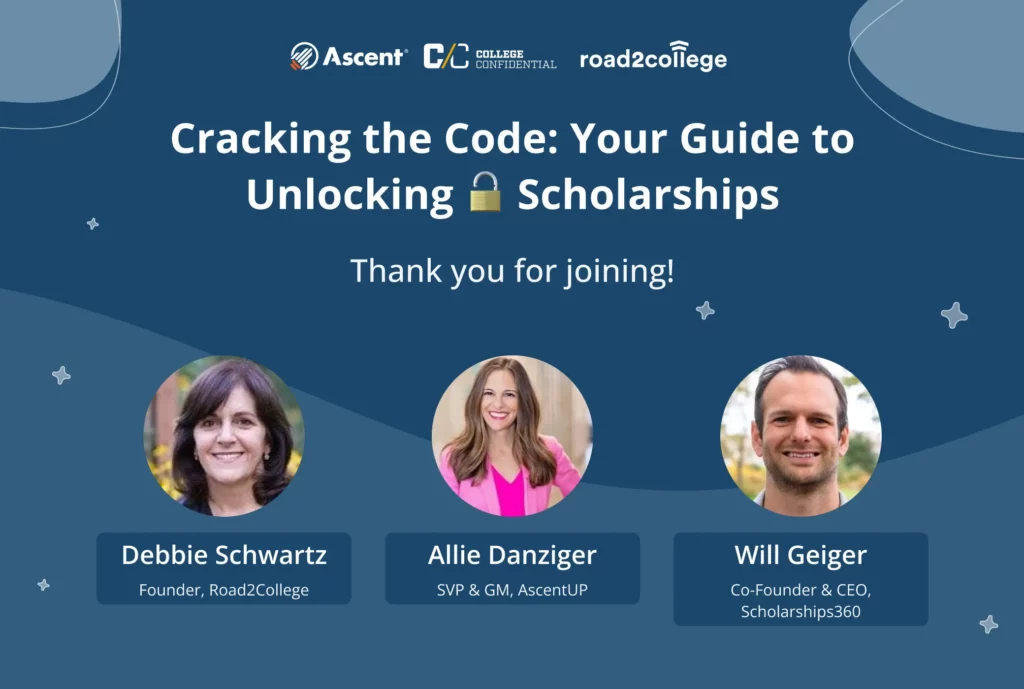 Webinar Recap: Cracking the Code on ScholarshipsAs the cost of education increases, scholarships have become a lifeline for countless students looking to pursue their academic dreams. However, with so much competition and so many options, the scholarship search can be disheartening. Understanding the nuances of scholarship applications, finding the right opportunities, and writing a winning scholarship essay remain daunting tasks for many. Luckily, Ascent and Road2College joined forces to discuss scholarship options, featuring panelists Will Greiger, Allie Danziger, and Debbie Schwartz. In case you missed our webinar, “Cracking the Code: Your Guide to Unlocking Scholarships,” you can watch some of the recording here: https://www.youtube.com/watch?v=X53OnJ5VQp0 What are the different types of scholarships? Understanding what types of scholarships are available is critical when trying to decide which ones to apply for. Will Greiger, CEO and Co-founder of Scholarships360, breaks down the four main types of scholarships: 1. Federal & government scholarships: These include grants such as the Pell Grant and other types of aid awarded through the Free Application for Federal Student Aid (FAFSA ®). Some states also have aid programs that fall into this category as well. 2. Scholarships from colleges: Like government scholarships, a college may also use information gleaned from your FAFSA to award you need-based aid. Many college scholarships are based off academics or talents (aka merit-based scholarships). A subset of college scholarships is a departmental scholarship, which you might earn for being in a specific area of study, studying abroad, or being a part of a club. 3. Non-profit scholarships: Non-profits are well-known for their generosity in scholarship awards. Some examples of these organizations would be the Elks Club, the Girl Scouts, or a smaller, local non-profit in your community. 4. Scholarships from private organizations: Many private companies also give out scholarships! To date, Ascent has given away over $330,000 in scholarships to students and families. Enter now for a chance to win one of our no-essay student scholarships – it only takes a few minutes! You do not need to have an Ascent loan to enter. https://www.ascentfunding.com/scholarships/ Common scholarship myths To get you started on the right foot, we take a moment to break down and debunk these top misconceptions about applying for scholarships: 1. “Only top achievers & athletes get scholarships” - While being a star athlete or straight A student can be a great thing to mention when applying for scholarships, there are plenty of opportunities out there if that’s not you. Researching for more niche scholarships that align with your unique passions, or entering more content style scholarships could be the best way to go. Plus, many scholarships are focused more on the financial need of the applicant, meaning federal and government scholarships may be a great fit for you! 2. “Scholarships are too competitive, so don’t bother applying!” - Applying for financial aid may feel competitive, but researching and applying for scholarships that align with your talents to boost you toward the top of the applicants. Applying for local scholarships will also mean less competition. 3. “Start researching for scholarships your senior year of high school” - While there may be plenty of scholarship opportunities out there during your senior year, there are scholarships available to you as early as your freshman year and plenty to keep exploring throughout your college journey. 4. “You must be a great essay writer to win scholarships” - Essay scholarships can feel daunting, and you should always invest time and effort into your submissions, but showcasing your creativity and who you are as an individual in your essay can be just even more valuable. Starting your scholarship search: Before diving into your scholarship hunt, our panelists suggest a quick look inward to find what you should be looking for in a scholarship: - Consider what makes you unique and start there. This will give you insight on the types of scholarships you should look for based off your passions, talents, and life experiences. - Be specific when you consider all the qualities of yourself that you might include in your scholarship research. Even the smallest or strangest interests could generate scholarship opportunities! - The more niche, the better! Finding a scholarship opportunity revolving around a lesser-known hobby or interest can mean less competition and a better chance of winning that money for school. A few key takeaways: As you embark on your journey of paying for college, we’ll leave you with these four key takeaways to keep your scholarship search successful: 1. Scholarships offer invaluable financial support for students and families on their educational journey. 2. Start your scholarship search early to maximize your opportunities 3. Leverage your various scholarship research tools, including online platforms, educational institutions, and organizations 4. Apply for as many scholarships as you can! Congrats to our latest scholarship winner! One of our top priorities at Ascent is to contribute to the success of all students. That’s why we have given over [scholarship_awards_amount] in scholarships to date! Join us in congratulating our most recent scholarship winner below: Kamiyah B., Pace University, Unlocking Scholarships $500 Scholarship Giveaway
 -
 How Long Does it Take to Get Student Loans? (Federal and Private)How long does it take to get a student loan? Factors such as when you submit the Free Application for Federal Student Aid (FAFSA®), your credit score, and the loan certification process all play a role in determining when you will receive your student loan funds. However, we understand that you must get your student loans in time to pay for tuition, books, and other college expenses. Let’s unpack how long the application and review process takes for federal and private student loans and the steps you can take to get ahead of the process. Key Takeaways Start your student loan application as early as possible—ideally right after your college acceptance—to give yourself enough time to complete paperwork, resolve issues, and secure funding before tuition is due. Federal student loans typically take several weeks to a few months to process, depending on when you complete the FAFSA and how quickly your school certifies the loan. Private student loan timelines vary by lender but often take anywhere from a few days to a few weeks, depending on eligibility checks, credit evaluations, cosigner involvement, and school certification. Loan disbursement usually happens shortly before the academic term begins, with funds going directly to the school to cover tuition and fees. Monitor your loan status using lender-specific portals or federal tools like the FAFSA mobile app, and contact your lender directly if you haven’t received your loan funds by the expected date. When to Apply for Student Loans The best time to apply for student loans is as soon as possible. For most students, this is shortly after their acceptance. There are several reasons for this timeline. Overall, loan providers (including the federal government) receive increasing applications as the school year approaches. Some loans and other forms of student aid are granted on a first-come-first-served basis, meaning that an earlier application makes it more likely you will receive them. Because timing fluctuates considerably from applicant to applicant, it’s challenging to estimate exactly how long it takes for student loan approval. However, you should still be aware of the general timeline for the process. Starting the loan application process as early as possible will help save you some stress in the long run and may even increase your chances of securing funding. It’s also important to consider that even if you qualify for federal loans, these may only cover part of the cost of college attendance. Because of this, it’s common to apply for other financing options, such as private student loans, or alternative forms of financial aid, such as grants and scholarships. Starting the application as soon as possible will give you more time to find supplemental funding if needed. How Long Does it Take to Get Federal Student Loans? How long does it take to get a student loan from the federal government? The average time to receive your funds can vary significantly based on several factors, primarily when you fill out your FAFSA application. The process generally takes several weeks to a few months, depending on how many applications they receive. Here is a general list of steps to be completed to receive your funds: Create an FSA ID: The Federal Student Aid (FSA) is your electronic signature for the FAFSA and other federal student aid documents. To create your FSA ID, visit https://studentaid.gov/fsa-id/create-account/launch. Gather necessary information: You will need your Social Security Number, full name, date of birth, tax information, and other details about your family’s financial situation. Complete and submit the FAFSA: The Free Application for Federal Student Aid is the application for federal student aid and will determine your qualifications for federal student loans. Receive and review your Student Aid Report (SAR): After processing your FAFSA, the government will send you your SAR. Review for accuracy and make any necessary corrections. Review financial aid offers: Colleges and universities you have applied to will send you financial aid offers once your FAFSA has been processed. Accept or decline federal student loans: If you choose to accept the loans, you will follow the instructions provided by the school. Complete entrance counseling: If you are a first-time borrower of federal student loans, you must complete entrance counseling to learn about your rights and responsibilities as a borrower. Sign the Master Promissory Note (MPN): The MPN is a legal document in which you promise to repay your federal student loan. How Long Does It Take to Get a Private Student Loan? Like federal loans, the typical timeline can vary. This is because each lender has its process, and each applicant must navigate it uniquely. Generally, most applications take a few days to several weeks or months. Here is a general list of steps to complete when working with Ascent to receive your funds: Determine loan amount – Calculate the amount you need to borrow, including tuition, fees, living expenses, and other educational expenses. Remember that private loans can cover up to 100% of the total cost of attendance, minus other aid received. Check your eligibility – Every lender has eligibility requirements for borrowers, but most consider credit history, income, enrollment status, and similar factors. Gather necessary information – The exact information required will vary but will likely include personal, academic, and financial information. Apply for the loan – Most loan applications can be completed online or at a lender’s office. Pass the credit check – Most lenders require a credit check to determine your creditworthiness. With Ascent, you can check your rate in under 3 minutes without impacting your credit score. Find a cosigner if necessary – If you lack sufficient credit history or do not meet the eligibility requirements of the loan, you may need a cosigner. (Even if you qualify without a cosigner, applying with one may qualify you for a lower rate or better terms). Get the loan approved – The lender will review your application after it’s submitted. Review and accept loan terms – If you are conditionally approved, you must carefully review all the loan terms, including interest rate, fees, and repayment terms. Then, you must decide whether to accept the loan offer. Complete school certification – Once you accept the loan offer, the school’s financial aid office may need to certify the loan amount by confirming your enrollment status and ensuring the loan amount adheres to the school’s cost of attendance. Finalize the loan – Complete any additional requirements the lender demands, such as signing the loan or providing additional documentation. Once your loan is finalized, review your loan terms and conditions to determine when the payment will be issued to your school. For example, Ascent’s student loans are distributed to schools on the second Wednesday after the program starts. How to Monitor Your Student Loan Status For a federal student loan, you must first access your personal FSA account to monitor your federal student loans. From there, you can view loan details and identify the loan servicer for each loan. You can also create an account on studentaid.gov using our FSA ID to access your federal student aid information and manage your loans. There is also a Federal Student Aid Mobile App that can help monitor your federal loan status. The process of monitoring your private student loans will vary significantly from lender to lender. The best way to begin is to contact your lender directly. Check your loan agreement or the lender’s website for contact information. Many lenders have an online portal where you can log in to view your account, while some (including Ascent) may offer a mobile app for added convenience. If you have specific questions or concerns about your student loan, contact your lender’s customer service department or the phone number on your monthly statement. If you’d like to contact your dedicated Ascent college student loan specialist, contact us at 877-216-0876 or [email protected]. Private Student Loans vs. Federal Student Loans: What’s Right for Me? Choosing what type of loan is right for you is entirely determined by your unique needs and circumstances. Some students will find that federal loans alone will meet their needs, but most will find they will need additional funding sources. Similarly, the amount of aid available to students will dramatically differ based on needs. The only way to know for sure whether federal, private, or both student loans are the right choice for you is to complete the application process and compare your options. Whatever option you choose, you must begin the process as soon as possible to give yourself the most time and options. For more information about student loans, visit our Student Loans 101 page or learn how to get a student loan. Learn More with Ascent Prioritizing your student financial aid and ensuring it is all in place before you start your college education is crucial to your success with the loan process. That means you should start the student loan application process as soon as possible. Luckily, you can start the process today. Ascent offers a variety of undergraduate student loans and graduate student loans to help you achieve your financial goals and academic dreams. With cosigned student loans and no cosigner student loans, you can find a loan type that best fits your unique needs. How Long Does it Take to Get a Student Loan FAQs How Long Do Student Loans Take to Process? The time it takes to process a student loan varies significantly by the lender and the school. While some loans may be processed in as little as a few days, others may take several months. Are Student Loans Given to You Immediately? Most student loans are paid out after some time and will be disbursed directly to the school shortly before the start of the school year. Why Hasn’t My Student Loan Been Disbursed? The only way to find out why your student loan hasn’t been disbursed is to contact your lender and speak with one of their representatives. Some common reasons why a lender would not have disbursed a student loan include incomplete loan requirements, enrollment status, school certification delays, incomplete verification process, incomplete loan acceptance, or the loan not yet scheduled to be disbursed.
Tips to save
Ways to earn
Your Ultimate Guide to College Funding
Discover interactive tools, expert insights, and real-world strategies to help you pay for college with confidence.