-
 Do You Need a Cosigner for Student Loans?Not sure if you need a cosigner for your student loans? Learn more about the different factors you should consider to help you decide.
 -
 What to Do if You Can't Get a Cosigner for a Student LoanWondering what to do if you can't find a cosigner to cosign your student loan? Read about five options you can explore!
 -
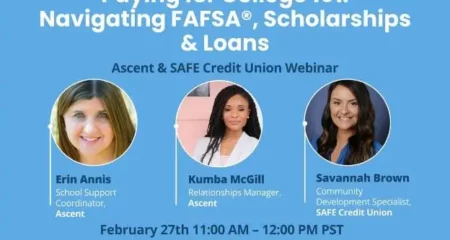 Major Takeaways from Ascent & SAFE Credit Union Webinar: Paying for College 101Major Takeaways from Ascent & SAFE Credit Union Webinar: Paying for College 101: Navigating FAFSA®, Scholarships & Loans With tuition costs on the rise, securing financial aid is key to making higher education more affordable and reducing financial stress. Understanding your options—grants, scholarships, work-study programs, and student loans—can help you navigate the process with confidence. We partnered with SAFE Credit Union to host a webinar, “Paying for College 101: Navigating FAFSA®, Scholarships & Loans.” We gathered expert panelists from Ascent including Erin Annis, School Support Coordinator, and Kumba McGill, Relationships Manager, to speak with the Event Host, Savannah Brown, Community Development Specialist at SAFE Credit Union. The discussion focused on demystifying financial aid, offering practical tips, guiding students through the FAFSA process, and answering valuable questions. If you missed the webinar, no worries! Feel free to watch it here. Understanding your financial aid options is crucial for making informed decisions about financing your education. Our panelists thoroughly reviewed four types of financial aid: federal and state grants, scholarships, work-study programs, and student loans. FAFSA®, also known as the Free Application for Federal Student Aid, is the key to accessing federal financial aid, including grants, scholarships, work-study, and loans, with many states and colleges using it for additional aid. Submitting it early maximizes funding opportunities, making college more affordable through need-based aid and low-interest loans. Our panelists suggest that if you have these qualities, you are eligible to submit an application: Financial Needs You need money to help pay for your education High School Diploma or GED U.S. Citizen and eligible non-Citizens Enrolled or accepted in an eligible degree or certificate program To maintain your eligibility, we advise you to do the following: Maintain a +2.0 GPA Do not default on any student loans Keep your non-citizen status intact Do not get it revoked Enroll in a qualifying degree/certificate program Reach the maximum amount you can borrow from the federal government for a lifetime To get you started, our panelists guided students and parents through the process of how to complete the FAFSA application. Before beginning the process, here are some quick notes: Students should start and complete this application as soon as possible and regardless of if they think they qualify Parents will have to fill out their own sections if students are dependent Under the age of 24, not married, no children, not in the military or homeless Students and parents must use different email addresses when creating their FSA ID Pro Tip: If you're unsure about a question, use the “Hint (?)” icons for guidance on providing exactly what is needed. Next, our panelists recommend you grab a cup of coffee or tea to carry you through this hefty process: To stay prepared, you should have the following documents beside you: 2023 federal tax forms and W-2's Untaxed income Child support Verterans’ non-educated benefits Supplemented Support Income (SSI) Cash and investment balances Your top schools Up to 20 options Financial aid offers Here are the steps to completing the FAFSA application: Log into FAFSA.gov Use your FSA ID Used as your electronic signature Save this along with your password! If you submitted FAFSA last year, use same FSA ID Fill out FAFSA Sections 36 questions Enter basic demographic information Insert your college choices Choose your dependency status Questions to determine your dependency If dependent, answers all questions “No” Parents need to fill out their portion Fill out parents’ information and income IRS DRT: invite, consent, and approval are required Fill out student income IRS DRT Sign, submit, and you are all done! Included are important due dates and deadlines to consider: 2025-2026 FAFSA forms are available now! Submit them by 11:59 CT, June 30, 2025 Schools send financial aid offers estimated by mid-to-late February Look out for the following: School/ state deadlines for institution or state aid/grant School offers Institution aid First come first serve Complete the application as soon as possible! Phew! Now that we have covered the FAFSA application process, you have access to a wide range of financial aid opportunities. In addition to federal and state grants, we’ve outlined three more key sources of financial aid to help support your education: Scholarships & Grants: “Free Money,”, no payment required! Federal & State Grants Free aid based on financial needs (ex. Pell Grants, FSEOG) Scholarships Merit-based, need-based, specialized opportunities Local & national databases provide access to thousands of scholarships Private companies and organizations To date, Ascent has given away over [scholarship_awards_amount] in scholarships to students and families. Enter now for a chance to win one of our easy-to-apply, no-essay scholarships! You do not need to have an Ascent loan to enter. Here are some strategies to secure a scholarship or grant: Tailor your applications to the specific scholarship/grant Write compelling essays that draw in your readers Track deadlines – apply early! Work Study Programs: Earn While You Learn Need-Based Aid Paid towards tuition Determined by FAFSA Part-Time Employment Earn money for expenses through on-campus employment Direct Pay & Earnings Wages paid directly to students, not applied to tuition How to Apply? Job Application is required Apply for and be hired by campus departments Funding for campus jobs Departments receive funding for positions, students actively seek & secure employment to utilize the award Student Loans: Federal vs. Private Federal (FAFSA required!) Lower interest rate, flexible repayment options Subsidized loans: interest is not charged while in school Unsubsidized loans: interest is charged while in school Private Best used after exhausting all federal aid options Compare lenders: interest rates, repayment terms, benefits Paying for college may seem overwhelming, but with the right resources and knowledge, you can navigate the financial aid process with confidence. From FAFSA® and scholarships to work-study programs and student loans, there are many ways to make higher education more affordable. By applying early, exploring all funding options, and staying informed about deadlines, you can maximize your financial aid opportunities and set yourself up for success. Remember, you're not alone on this journey! Ascent and SAFE Credit Union are here to support you with valuable resources, scholarships, and guidance.
 -
 Finding a Cosigner for Your Student LoansFinding a cosigner for your student loan can be a difficult process. Ascent has four tips for finding a cosigner for your student loan.
 -
 How Parents or Guardians Can Help Their Child Get a Student LoanAs a parent or guardian of a college-bound student, it’s important to ensure your child is financially prepared to cover the cost of higher education. And as Decision Day approaches, you might wonder whether your child can get a student loan on their own, or if they will need your financial support. Read on to learn if parents or guardians can apply for student loans, which student loan options are available to parents, and what to be aware of when taking out a student loan in your name. Key Takeaways Parents, guardians, or sponsors can support students by cosigning private loans or taking out loans in their name, such as federal Parent PLUS Loans. Parent PLUS loans come with fixed interest rates, income-based repayment options, and potential loan forgiveness. Private student loans vary by lender but may offer higher loan limits, lower interest rates, and cosigner release. Parent-borrowed loans may offer better terms based on credit, but also come with full repayment responsibility. Compare interest rates, terms, and protections carefully. A financial aid advisor can help guide your decision. Can a Parent or Guardian Take Out a Student Loan for Their Child? Parents or guardians can take out a student loan for their child, which can be beneficial for several reasons. One key advantage is that you may qualify for a substantially larger loan amount than your child could on their own. Creditworthiness is generally a major factor in the loan approval process, and it is not uncommon for students to have little or no credit history. In some cases, students may be unable to qualify as solo borrowers. You may also qualify for a lower interest rate on a student loan than your child could for similar reasons. Securing a lower interest rate can save your child a considerable amount over the lifetime of the loan. Additionally, depending on your qualifications, you could receive more favorable loan terms in other ways, such as more flexible repayment options. Applying for a parent student loan or a cosigned student loan are two options parents can consider, with one major difference. With a parent student loan, you (the parent), or the grandparent, guardian, or sponsor taking out the loan is solely responsible for repayment. With a cosigned student loan, on the other hand, you are accepting shared responsibility for repaying the loan if the primary borrower cannot. A parent student loan does not require the student to qualify, nor does the student carry any financial obligation to repay the loan. Opting for a cosigned student loan, however, can help your child build their credit history, if the loan is paid back on time. Types of Student Loans Available to Parents Two primary types of student loans are available to parents or guardians: federal parent PLUS loans and private student loans. Federal Parent PLUS Loans Federal parent PLUS loans, also known as Direct PLUS loans, are provided by the federal government and are designed for biological or adoptive parents. Parent PLUS loans cover the difference between the amount of federal student aid a student receives and the full cost of attendance, which is also the maximum amount of a parent PLUS loan. To apply for a parent PLUS loan, your child must fill out and submit the Free Application for Federal Student Aid (FAFSA®). Like any financial decision, taking out a parent PLUS loan should be evaluated carefully. While this loan type may provide more funding than other financial aid programs, parents should be conscious of borrowing only what they need—and can repay—to avoid long-term financial repercussions. Private Student Loans Various lenders, such as banks, credit unions, and other organizations, provide private student loans directly to parents, or as a cosigner. The application process and eligibility requirements vary by lender and loan type, as do the loan terms. Some lenders, like Ascent, also offer undergraduate student loans designed specifically for parents or guardians and cosigned student loans. Private Student Loans for Parents vs. Parent PLUS Loans There are several key differences between private student loans and federal parent PLUS loans. Advantages of parent PLUS loans include: Interest Rates: Whereas private loan rates will depend heavily on the market and the borrower’s qualifications, a parent PLUS loan offers a fixed interest rate set by the federal government. Repayment Plans: Parent PLUS loans have various repayment plans, including standard, graduated, and income-contingent options. These plans provide flexibility for those looking for a plan that most closely aligns with their financial situation. Deferment and Forbearance Options: Parent PLUS loans typically have many deferment and forbearance options, which can be a lifeline should you experience economic hardship. Loan Forgiveness Programs: Parent PLUS loans may be eligible for the Public Service Loan Forgiveness (PSLF) program, which is highly advantageous for parents with qualifying public service jobs. Key features of private student loans include: Loan Terms: Private student loans offer more variety in terms of interest rates, and repayment plans, meaning that parents choose the best terms for their financial situation. Cosigner Release Options: Some private student loans offer the option of releasing the parent cosigner from loan obligations after the student meets certain loan repayment criteria. Approval Process Timeline: Private loans typically have faster application and approval processes than federal loans. Lending Limits: Private loans may allow parents to borrow significantly higher amounts, in some cases, the full cost of attendance. It’s important to note that the amount a particular parent borrower qualifies for will vary based on creditworthiness and lender. Additional benefits: Private student loan providers often offer additional benefits including cash back rewards, automatic payment discounts, or access to coaching resources like AscentUP. Pros and Cons of Taking the Loan Out in Your Name While there are many advantages to taking out a student loan for your child in your name, there are also some disadvantages. Let’s explore the pros and cons. Benefits of Parents Taking out a Student Loan Access to More Funding: Parents typically have more established credit histories than their children, so they can often qualify for higher loan amounts. Potentially Lower Interest Rates: While the federal government sets parent PLUS loans’ fixed interest rates, parents can often qualify for lower interest rates than their children on private loans. Alleviating Immediate Debt for the Student: A loan in your name removes some of the student's immediate financial burden, allowing them to focus on their studies. Things to be Mindful of When Taking out a Student Loan Responsibility Falls on You: You are ultimately responsible for repaying the loan, regardless if your student completes their program Impact on Your Credit: Taking out a loan can impact your credit, especially if it is for a large amount. Late or missed payments can hurt your credit score, and the loan will impact your debt-to-income ratio (DTI), which can impact your ability to secure other forms of credit. Opportunity for Open Discussion around Finances with Your Child: Mixing family and finances can be tricky, and the financial obligation of the loan should be met with openness and honesty. Open communication about expectations, repayment plans, and financial responsibilities can help prevent misunderstandings. Overview of the Student Loan Application Process for Parents Every private student loan has a different application process, so you must contact each lender to discuss the process for their graduate or undergraduate loans. However, the application process for federal parent PLUS loans is similar. For parent PLUS loans, the steps look like this: Complete the FAFSA. This determines eligibility for most federal student aid programs. Log in to StudentAid.gov. After submitting the FAFSA, use your FSA ID to log in to the Federal Student Aid website. Select “Apply for a PLUS Loan.” Use the “Apply for Aid” tab and choose “Apply for a Parent PLUS Loan” for the relevant award year. Complete the parent PLUS loan application. Provide the required personal and financial information on the application form, such as income, employment, and contact information. You must undergo a credit check. Unlike other federal student loans, the Department of Education assesses your credit history to determine eligibility. Sign the Master Promissory Note (MPN). If approved, you must sign the Master Promissory Note on the studentaid.gov website. This legal document outlines the terms and conditions of the loan and documents your promise to repay it. Receive a loan decision. The Department of Education will notify you whether you’ve been approved for the loan, along with the loan amount and terms. Accept or decline the loan. You can accept the full loan amount, choose a lower amount based on your child’s specific needs, or decline the loan if you no longer need it or have found a better option. Tips on How to Determine Which Type of Student Loan Is Right for Parents Now that we’ve established that parents can take out student loans for their children, the next step is figuring out which loan type best suits their needs. Here are some tips for determining which loan is best for your financial future and your child’s education. Evaluate Your Financial Situation. Assess your income, savings, existing debts, and overall financial capacity to determine what loan repayments you can afford. Research Available Options. Understand federal and private options regarding interest rates, repayment plans, borrower protections, and other terms to determine which best aligns with your needs. Compare Interest Rates. Consider whether fixed or variable rates are more advantageous to you and the specific rates offered on specific loans. For example, if you value the predictability of a fixed rate with ample deferment and forbearance options, a parent PLUS loan might be your best bet. Compare Loan Limits to Need. Different loans have different limits, which may or may not meet your child’s needs. Understand Repayment Options. Different loans offer different repayment options, some of which may be more advantageous for your situation. Assess Your Creditworthiness. Evaluate your credit history and credit score to understand how they might impact your loan approval, interest rates, and available loan terms. Consider Cosigning. Evaluate whether it would be better to be a cosigner yourself or find another cosigner, especially one with a strong credit history. Review Available Borrower Protections. Consider whether deferment, forbearance, loan forgiveness programs, and cosigner releases are available. Seek Professional Advice. Financial aid advisors and student loan experts can provide personalized guidance based on your circumstances and needs. Contact our support team today! Learn More with Ascent Ascent is committed to helping students achieve their goals in college and beyond. That's why we offer a library of financial wellness resources and a variety of loan options to meet your financial needs. Learn more about our college loan options for parents. FAQ Do parents need to cosign student loans for their children? Parents often do not need to cosign student loans for their children if the student borrower can qualify independently. However, cosigning a loan for your child may increase the total loan amount available, reduce interest rates, and secure more favorable terms. Can my child get a student loan on their own? Whether your child can get a student loan independently depends on several factors, including their financial need, creditworthiness, credit score, and the school’s total attendance costs. The best way to determine this is to have them fill out the FAFSA, apply for federal student aid, and then apply for private student loans to address any remaining funding gaps. Application criteria will also vary by lender. How do you get private student loans for parents with bad credit? Although getting private student loans for parents with bad credit can be more difficult, there are options. Some lenders may have more flexible credit requirements or allow collateral to secure the loan. You can also investigate lenders who specialize in helping borrowers with bad credit.
 -
 How to Remove a Cosigner from a Student LoanAlthough cosigners can be beneficial, you should know how to remove them from a student loan. Learn how to remove a cosigner with Ascent.
 -
 Pros and Cons of Community College Compared to UniversityMore high school grads are going straight to community college after graduation. Learn why students are choosing community college after high school.
 -
 Subsidized vs. Unsubsidized Student Loans: What's the Difference?Subsidized and unsubsidized loans are part of the federal direct loan program and offer students various loan options. Learn more.
 -
 FAFSA Eligibility: Who Qualifies and Income LimitsWondering if you qualify for federal financial aid? Learn more about the eligibility requirements while submitting your Free Application for Federal Student Aid (FAFSA).
 -
 What Is Student Loan Forbearance and Do I Qualify?Ascent Funding explains what student loan forbearance is and what the pros and cons of forbearance are. Learn more and see if you qualify.
 -
 How Is Your SAI (Previously Expected Family Contribution or EFC) Calculated?EFC stands for Expected Family Contribution and is a number used in the FAFSA process to help calculate your eligibility for financial aid. Learn more about EFC and the switch from EFC to SAI.
Tips to save
Ways to earn
Your Ultimate Guide to College Funding
Discover interactive tools, expert insights, and real-world strategies to help you pay for college with confidence.