-
 Ascent Recognized as One of Southern California's Best Places to WorkWe’re proud to share that Ascent has been recognized as one of Southern California’s Best Places to Work by Best Companies Group, an independent organization that honors companies creating strong workplace experiences for their teams. Best Places to Work SoCal is a research-driven program from Best Companies Group that reviews participating companies’ practices, programs, and benefits, then gathers employee feedback about their workplace experience. Companies that meet the program’s criteria are named among the Best Places to Work SoCal. For Ascent, this recognition reflects more than our benefits or programs. It reflects the people who make our work meaningful every day. At Ascent, we’re focused on building a workplace where people feel supported, trusted, and able to grow. Our mission is to help students access education and move toward academic and economic success, and we know that work starts with our own team. When employees feel valued and connected to the work they do, they’re better equipped to make a meaningful impact. Our team is curious, collaborative, and open to new ideas. Leaders encourage learning, create space for feedback, and support career growth across the company. We believe great ideas can come from anywhere, and we work to make sure employees feel heard, included, and empowered to contribute. Supporting employees means supporting the whole person. Ascent offers flexible and hybrid work options, generous PTO and leave policies, paid parental leave, wellness support, continuing education opportunities, and a 401(k) match. These benefits are designed to help team members care for themselves, grow professionally, and build sustainable careers. Recognition is also part of how we show appreciation. Through programs like Cosmic Kudos, professional development opportunities, and company-wide celebrations, Ascent makes time to acknowledge the work happening across the team. It’s one way we help create a culture where people support each other, celebrate progress, and take pride in the impact they’re making. “We’re proud to have built a workplace where employees feel trusted, supported, and genuinely connected to the work they do,” said Emily Skoubo, Director of Human Resources at Ascent. “This recognition reflects the collaborative culture our team has created together and our continued focus on providing an environment where people can grow, contribute, and feel valued.” At its core, Ascent’s culture is people-first and purpose-driven. Team members support one another, celebrate wins together, and stay connected to a shared goal: helping students and families plan for, pay for, and succeed in school. That mix of mission, collaboration, and opportunity is what makes Ascent a great place to work. We’re grateful to every employee who helps shape that culture every day and proud of what we’ve built together. As Ascent continues to grow, we’ll keep investing in our people, strengthening our culture, and creating opportunities for employees to do meaningful work while building rewarding careers. Because when our people succeed, the students and families we serve benefit too.
 -
 Can International Students Apply for FAFSA?Even though international students can't receive aid from the U.S government, it's still important to complete the FAFSA. Learn more from Ascent Funding.
 -
 The Different Types of Financial Aid Explained: Loans, Grants, & Work-Study ProgramsTypes of Financial Aid Explained: Learn about the different types of financial aid available for students, including loans, grants, and work-study programs.
 -
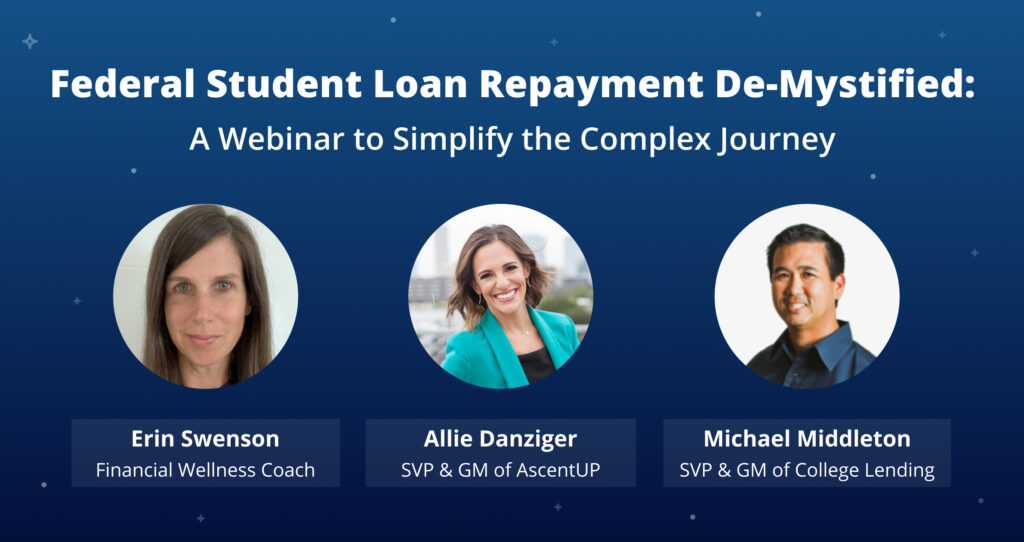 Confused about Federal Student Loan Repayments? Questions from Students, Answers from AscentAscent hosted an engaging webinar to address what’s on many people’s minds - federal student loan repayment. We know that embarking on this journey can be overwhelming and you're not alone. According to NerdWallet, “nearly 44 million borrowers with student loans” are entering repayment. We're committed to supporting individuals every step of the way. Our recent webinar, 'Federal Student Loan Repayment De-Mystified,' covered several topics ranging from how to prepare for repayment to understanding your repayment plan and exploring the invaluable resources available for those making budget adjustments. We want to offer resources and address some important audience questions we didn’t have time to cover and provide guidance and support on this complex topic. There are some great options for student loan repayment. What are the potential downsides to an Income Driven Repayment plan (IDR)? Income Driven Repayment (IDR) plans may be a good option for students that are unable to make their required payments under a standard, graduated or extended repayment plan, have low income or are enrolled in the Public Service Loan Forgiveness program, among other reasons. However, it is not always the best option for all students. Some of the disadvantages of IDR's include: You might not qualify for a lower payment than under a standard repayment plan Depending on which IDR plan, loan balances may increase as well as total cost of the loan due to unpaid interest It will generally take longer to fully repay the debt obligation Monthly payments may increase as your income increases There may be tax consequences for forgiven loan balances, and you may want to consult a tax professional What if my monthly payment is too high? How can I reduce this to a manageable amount? According to StudentAid.gov, “Most federal student loans are eligible for at least one income-driven repayment plan. If your income is low enough, your payment could be as low as $0 per month.” Start by exploring the new SAVE plan and use the Loan Simulator. This tool will help you explore repayment options that fit your needs. You can also reach out to your Loan Servicer to explore options for reducing your monthly payment. To find your Loan Servicer: Log into StudentAid.gov, view your Dashboard and access their information on the right-hand side panel. What is PSLF and how can I qualify? The Public Service Loan Forgiveness is a program for individuals employed by a government or non-profit organization that forgives the remaining balance on your direct loans: If you are working full time for an eligible employer After you’ve made the equivalent of 120 qualifying monthly payments under an accepted repayment plan The PSLF Help Tool is a great place to start and will help you: Search for qualifying employers List what actions you may need to take to become eligible Generate a PSLF form (tip: You must complete the form in a single session) Need more info? Check out this helpful FAQ about PSLF What types of student loan repayment options are there for Parent Plus Loans? Parent PLUS borrowers are eligible for the following repayment plans: Standard Repayment Plan Graduated Repayment Plan Extended Repayment Plan According to StudentAid.gov, “Parent borrowers can become eligible for an additional repayment plan—the Income-Contingent Repayment Plan—by consolidating their parent PLUS loans into a Direct Consolidation Loan.” If you have concerns about making payments, reach out to your Loan Servicer to discuss your options. Need more info? Check out these Parent Plus FAQs The conversation is far from over The conversation is far from over. It's ever evolving, and we recognize the importance of this topic for enrolled and unenrolled students, graduates and cosigners. We're dedicated to delving deeper and bringing more insights, advice, and conversations in the coming weeks. Stay tuned and keep sharing your questions, concerns, and personal experiences as it helps shape these discussions and strengthens our Ascent community.
 -
 How to Get a Student LoanThere are several ways to get student loans, with a cosigner or without. Read how to get a student loan here to learn more.
 -
 How to Apply for Grad School LoansIf you're attending graduate school, our step-by-step guide will help you figure out where to start with the loan application process.
 -
 Ascent Parents Speak On Student SuccessNew adventures can be intimidating—whether it’s moving to a faraway campus, exploring some new classes, or furthering a budding career with a bootcamp program, there’s a lot to prepare for.
 -
 Your Guide to Voting in College: Tips for Students and First-Time VotersBeing a college student means you’re consistently busy.
 -
 What Are Parent PLUS Loans? Know the FactsWhat are Parent PLUS loans, and should you look into one? Ascent Funding breaks down what Parent PLUS loans are and explains how they can benefit students.
 -
 What is a 529 College Savings Plan? How to Save for Your Student’s College FundA 529 college savings plan is an investment plan to pay for various education costs. Learn more about 529 college savings plans from Ascent Funding.
 -
 How To Choose A Student Loan Lender: Important Factors To ConsiderWhen it comes to choosing a private student loan lender, who you work with makes a big difference. Learn more about what to look for from Ascent Funding.
Tips to save
Ways to earn
Your Ultimate Guide to College Funding
Discover interactive tools, expert insights, and real-world strategies to help you pay for college with confidence.